HPSC PGT Computer Science: A Recurrence-Based Revision Order for the Subject Paper
Use topic recurrence from past HPSC PGT Computer Science papers to order revision, while keeping the official syllabus and current paper structure in control.
KnowledgeGate Team
Exam prep & CS education
Updated 3 Sep 20267 min read

HPSC PGT Computer Science candidates often revise every subject at the same intensity. That feels fair, but it ignores the recurring core visible across previous papers and leaves dependable areas under-practised.
A recurrence read gives you a defensible revision order. It shows which blocks to secure first, where to spend timed-practice hours and which sub-topics should dominate your error log.
Reading the previous years honestly
Treat each recurrence band as a working revision order, not official weightage. On a check sheet, give each verified HPSC paper one row and each syllabus block one column. Tag every question once, keep the raw count beside its band and label a one-paper result as a priority list, not a multi-year trend.
Keep three sources separate:
The official syllabus defines what may be tested.
Previous papers show how that scope has been sampled in past cycles.
Your mock and practice data show which recurring areas you personally cannot yet convert.
Confirm the live composition, marks and dates on the official HPSC portal. Use the Government Teaching Jobs category to compare routes, not notification specifics.
The high-recurrence CS blocks
DBMS, Computer Networks, Operating Systems, data structures and programming form the clearest recurring core and should receive your first revision cycle.
Practise these subjects through recognisable question forms. In DBMS, identify the highest normal form a given relation satisfies, or trace a schedule to test it for conflict-serializability. In Networks, work through a subnetting and usable-host calculation, or reason about how a protocol behaves under loss. In Operating Systems, trace CPU scheduling under FCFS or SJF, or count page faults for a replacement policy. For data structures and programming, follow pointers and control flow through a linked-list, tree or code operation.
Each form exposes a different weakness. Record whether a miss came from a forgotten fact, a confused rule, a skipped trace or poor time control, then use the three recurrence bands to set the order of repair.
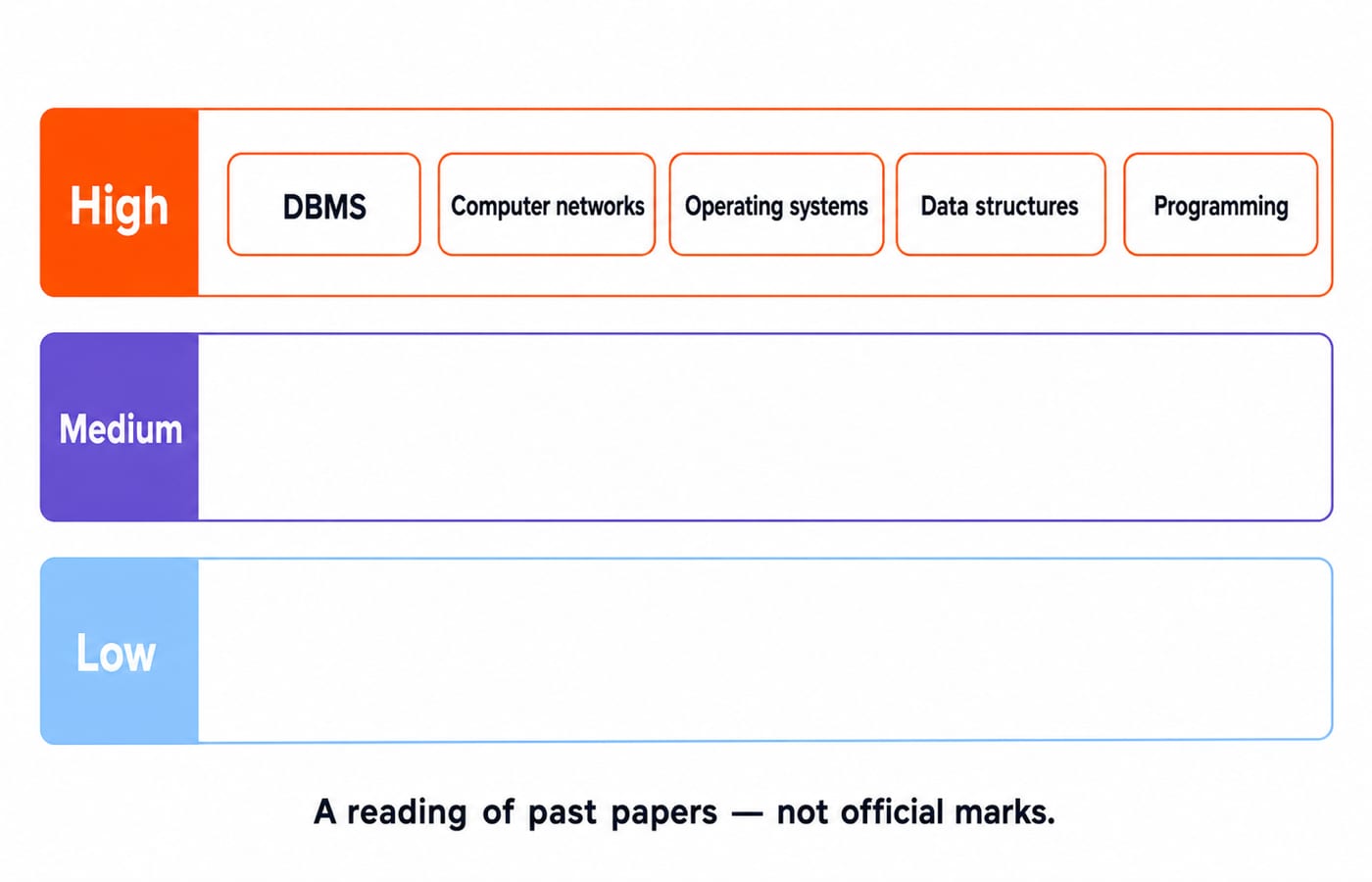
Use the high band to decide what you secure first, while keeping the middle and lower bands in the plan. A useful first pass should produce:
one concise rules or formula sheet for each high-band block
a list of the pairs candidates confuse, such as candidate key and primary key, process and thread, or deadlock and starvation
a timed mixed set covering recall, computation, trace and behaviour questions
an error log grouped by DBMS, Networks, OS, data-structure and programming sub-topics
a full re-solve of every missed, guessed or unfinished trace
You can practise with well over 18,000 Computer Science questions across these areas. Vary the question forms instead of repeating the set that already feels familiar.
A worked trace from the high band: FIFO page faults
Take three page frames and the reference string 1, 2, 3, 1, 4, 5 under FIFO replacement. Work it the way the paper expects, one access at a time, writing the frame contents after every step.
1, 2 and 3 each fault on arrival and fill the three empty frames.
The second 1 is already resident, so it is a hit and nothing changes.
4 faults. FIFO evicts 1, the oldest arrival, leaving 2, 3 and 4 in memory.
5 faults. FIFO evicts 2, the next oldest, leaving 3, 4 and 5.
That is 5 page faults in 6 accesses. The step candidates fumble is the hit on 1: a hit never refreshes FIFO's arrival order, so 1 is still the oldest page when 4 arrives. Under LRU the same string evicts 2 at that point, because the hit made 1 recently used. Option-setters build distractors on exactly that difference, so name the rule you are applying before you evict.
The mid and low recurrence blocks
Computer organisation, digital electronics and software engineering form the middle band and warrant a controlled first allocation.
In computer organisation, secure computer representation, memory, instructions and I/O before pushing into finer detail. In digital electronics, connect number systems and Boolean rules to standard circuits, so a base conversion or a Boolean-simplification question is routine rather than a surprise. In software engineering, organise the life cycles, requirements, design and testing by purpose and sequence, since a common question simply asks which phase an activity belongs to.
Theory of computation and heavier discrete mathematics form the lower band. Cap the first pass at core definitions, automata, grammars, closure ideas, graphs and direct counting.
Low here is a sequencing decision, not a verdict on importance. DBMS, Networks and OS take priority while weak; expand tail coverage once the high and middle bands are dependable.
The general and Haryana recurrence pattern
Give the non-CS portion a separate lane for Haryana history, geography, economy, current affairs, schemes and broader general awareness. Its recall method differs from technical CS.
Maintain two revision trackers:
Track | What goes in it | Best review method |
|---|---|---|
Computer Science | Concepts, procedures, code traces, formulas, confused pairs | Topic sets, mixed tests and written re-solving |
Haryana and general | Facts, themes, institutions, current updates and eliminations | Short notes, spaced recall and current-source updates |
Protect a fixed Haryana and general slot. Do not let it consume every session or postpone it until spaced factual recall is no longer possible.
Use the DSSSB TGT Computer Science previous-year analysis to compare preparation methods, not paper structures.
What recurrence means for your prep order
Build revision in three passes.
Pass 1: secure the recurring core. Revise DBMS, Networks, OS, data structures and programming. Follow each subject review with timed questions while the method is fresh.
Pass 2: make the middle band reliable. Cover computer organisation, digital electronics and software engineering to the standard-result level. Add the Haryana and general slot throughout this pass.
Pass 3: cap the tail and mix. Give theory of computation and heavier discrete mathematics their planned pass, then use mixed sets that force rapid switching among subjects.
Use test evidence to adjust the sequence. Maintain accurate high-recurrence blocks and repair those with repeated concept errors. Recurrence sets the start; performance sets the final allocation.
Build speed after method. Re-solve while naming each rule, then attempt a fresh timed set to separate knowledge gaps from timing problems.
Traps in reading previous years
Assuming the last paper will repeat. The most recent paper stays freshest in memory, so its exact arrangement starts to look like a template. Build a plan around it, and a normal year-to-year shift leaves whole blocks under-revised. Compare recurrence across several papers, and prepare each repeated concept in more than one form.
Ignoring a current syllabus addition. A new topic has little previous-paper evidence, so it is easy to trust old papers and skip it. That leaves a fully eligible area uncovered. Add every current syllabus topic to the plan first, then let recurrence decide its depth and timing.
Treating difficulty as frequency. One painful question can dominate your memory and make its topic feel more common than it really is. Revision time then drifts towards a rare pattern while dependable areas wait. Count how often a topic appears separately from how hard it felt, and keep the two apart.
Turning bands into official weightage. Bands are useful because they organise preparation, which tempts candidates to read them as assumed marks or quotas. Treated as numbers they create false precision and can misdirect a timetable. Use the bands to sequence revision, and practise enough mixed sets to stay flexible across paper arrangements.
Copying another exam's pattern. A related exam offers ready questions, which makes its topic mix tempting to adopt wholesale, but the blueprints differ. The RSSB Computer Instructor previous-year analysis and weightage guide is a good example: treat its paper as an extra source of practice questions, not as a stand-in for HPSC evidence, and keep your HPSC recurrence record separate when you set priorities.
How HPSC tests it and where to confirm
HPSC's written stages test the same CS core at different depths. For screening practice, use definition, distinction, application and short-computation items that reward fast rule use.
For subject-knowledge practice, turn each concept into a written explanation or derivation: name the rule, show intermediate steps and state the conclusion. An MCQ-only routine leaves written recall weak.
Trace tasks require a visible state, such as a scheduling order, page-fault count or subnet result. For behaviour questions, explain what the protocol, OS mechanism or database rule does under the stated condition.
Practise the Haryana and general layer separately while learning, then combine both tracks in full tests. Confirm the current stage structure, syllabus and schedule in the latest official HPSC material.
The short version and your next step
Start with DBMS, Networks, OS, data structures and programming. Build the middle band next, cap the lower tail without deleting it, and protect a Haryana and general slot.
Test that order with the HPSC PGT Test Series, while the HPSC PGT CS 2026 Interview Preparation & Complete Course supports full coverage and current-stage preparation. Let recurrence choose the start and your error log choose the next session.
Keep learning
MS Word Basics: Editing, Formatting, a Worked Document and Exam Traps
Learn how Word applies commands to characters, paragraphs, pages and files. Build an ICT revision plan, audit every state change and avoid common exam traps.
Updated 23 Oct 20266 min readTeaching Recruitment (Computer Science)
Excel Functions and Charts Explained: Formulas, a Worked Sheet and Exam Traps
Learn how Excel formulas, references and charts work by building one mock-test worksheet from scratch. Every output is calculated and every common trap has a fix.
Updated 19 Oct 20265 min readTeaching Recruitment (Computer Science)
Digital Society Explained: Core Concepts, a Worked Inclusion Audit and Exam Patterns
Learn to separate access, skills and outcomes, audit digital inclusion with a worked funnel, apply data minimisation and solve common exam cases.
Updated 15 Oct 20266 min readTeaching Recruitment (Computer Science)
Common Editing Ctrl Keys Explained: Copy, Cut, Paste, Undo and Redo with Worked Examples
Learn what each common Ctrl key does, then trace the document, clipboard, cursor and edit history through precise examples without confusing Copy, Cut or Undo.
Updated 11 Oct 20266 min readTeaching Recruitment (Computer Science)