NIMCET Syllabus Decoded: Why Mathematics Carries the Paper (Section Weightage)
Read the NIMCET syllabus by section weight, not chapter order. Build mathematics continuously, use reasoning as the second pillar, and keep smaller sections controlled.
KnowledgeGate Team
Exam prep & CS education
Updated 5 Sep 20264 min read63 views
NIMCET aspirants often give Computer Awareness and English more time than their role in the paper justifies, then leave the biggest block under-practised. The syllabus looks like four sections, but the sections do not carry equal weight. Your timetable should reflect that difference.
The correct reading is mathematics first and continuously, reasoning as the second pillar, and the smaller sections as regular top-ups. That does not mean skipping anything. It means matching preparation depth to what can move the result most.
NIMCET has four sections
The paper is organised around four subject areas:
Mathematics
Analytical Ability and Logical Reasoning
Computer Awareness
General English
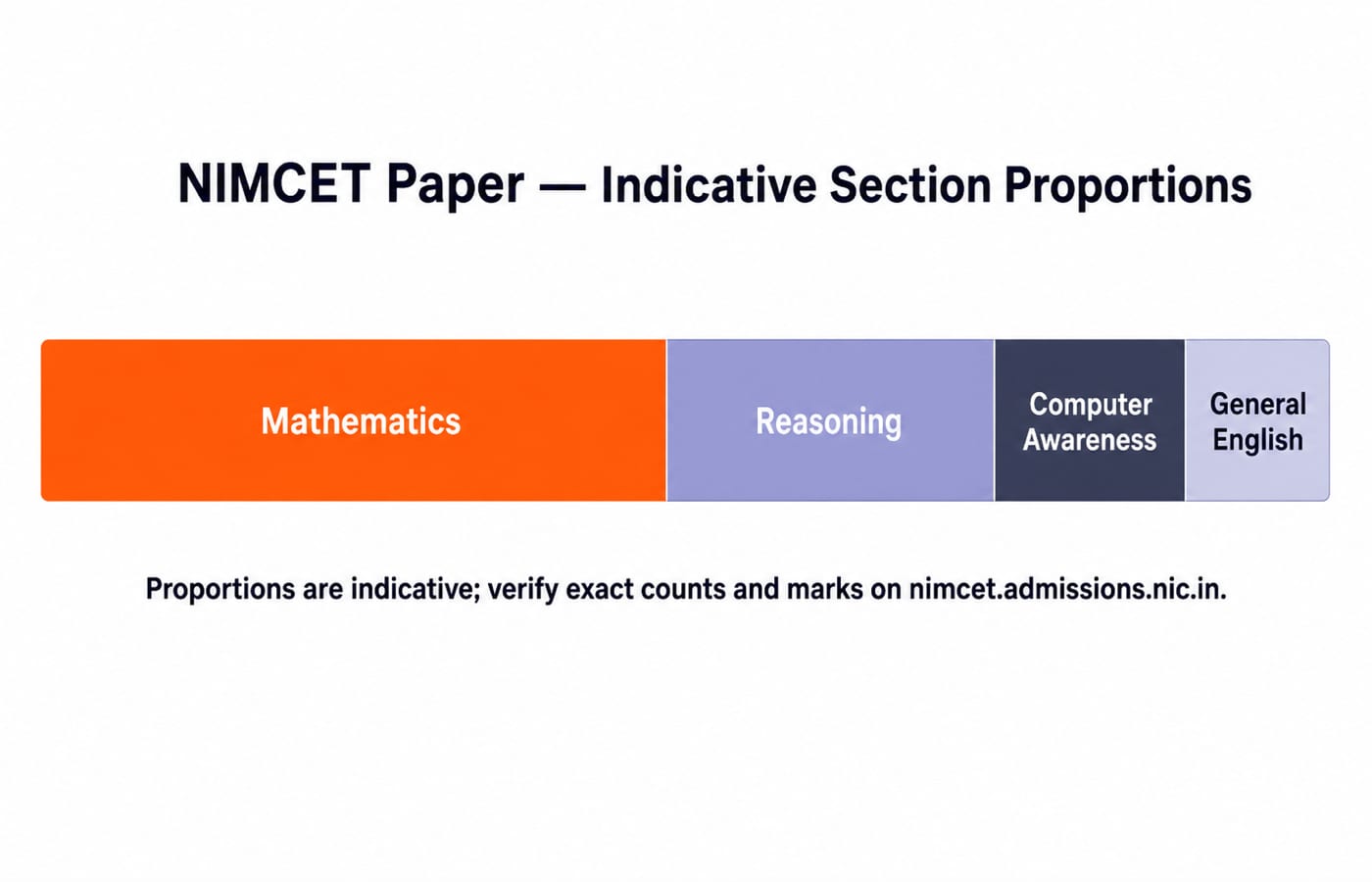
The NIMCET 2026 brochure gives mathematics 50 questions and 600 of the paper's 1,000 weighted marks. Analytical Ability and Logical Reasoning has 40 questions and 240 marks, Computer Awareness has 20 questions and 120 marks, and General English has 10 questions and 40 marks.
Mathematics: 600 marks, or 60% of the weighted total
Analytical Ability and Logical Reasoning: 240 marks, or 24%
Computer Awareness: 120 marks, or 12%
General English: 40 marks, or 4%
Mathematics supplies about 42% of the questions but 60% of the weighted marks because each correct mathematics answer carries more marks than an answer in the other sections. That is the precise sense in which mathematics carries the paper.
Those figures are from the NIMCET 2026 brochure. If you are preparing for a later cycle, use the official NIMCET information brochure to verify question counts, marks, negative marking, section timings, and any pattern revision before finalising your plan.
For chapter-level evidence, use NIMCET Previous-Year Analysis: How Questions Split Across Maths, Reasoning and Computers, which examines what appeared within each section in earlier papers. This post starts from the 2026 brochure's section split, so paper-to-paper topic variation does not change the baseline priority.
Mathematics is the block that wins the paper
Mathematics needs the longest runway because it combines wide coverage with multi-step problem solving. It is not a section you can finish once and leave. Concepts fade unless they are kept active through mixed revision and timed questions.
The NIMCET 2026 brochure groups the mathematical core into these broad areas:
set theory and logic
probability and statistics
algebra, including progressions, matrices, determinants, permutations and combinations
coordinate geometry
calculus
trigonometry
Because mathematics is both dominant and learnable, it is where sustained practice creates the largest change. Read a concept, work standard forms, solve a focused set, analyse errors, and revisit the same area in a mixed test. That loop is more useful than collecting formulas without application.
Reasoning, Computer Awareness and English
Analytical Ability and Logical Reasoning
Reasoning is the dependable second block. The syllabus includes verbal and non-verbal reasoning, coding-decoding, directions, seating arrangements, puzzles, syllogisms, series, statements and conclusions, data interpretation, data sufficiency, and related forms.
Pattern exposure matters here. Build a clean representation, such as a table for a seating puzzle or a short symbol map for coding-decoding, before racing to the answer. The logical reasoning guide for placement tests explains the same core families and is useful for additional drills.
Computer Awareness
Computer Awareness covers fundamentals such as computer organisation, CPU and memory, input and output devices, data representation, binary arithmetic, hardware, software, operating systems, internet use, email, and online safety.
This is smaller than the mathematical core, so prepare it efficiently. Use short concept notes, retrieval practice, and mixed questions. Number systems deserve actual conversion practice. Hardware and software terms need precise distinctions, not long descriptive reading.
General English
English covers comprehension, vocabulary, grammatical patterns, word and phrase meaning, technical writing, and accuracy of expression. A short daily routine works better than a late, isolated sprint: read a passage, review a few usage errors, and maintain a vocabulary list built from context.
Turn section weightage into a timetable
For a 20-hour preparation week, a sensible starting split is 12 hours for mathematics, 5 for reasoning, 2 for Computer Awareness and 1 for English. This 60:25:10:5 study split stays close to the official 60:24:12:4 marks split without pretending that study time is an official rule.
Use practice-test evidence to move one or two hours toward a weak section, but keep mathematics as the majority block unless your scores already show unusual strength there. The order remains:
Mathematics first: study it on most preparation days, with both concept work and questions.
Reasoning second: practise recurring types often enough that setup becomes quick.
Computer Awareness regularly: use short revision blocks and active recall.
English steadily: build reading and usage accuracy without displacing the mathematical core.
Map each block to focused practice
Match the practice format to the section instead of using one generic question routine:
Mathematics: learn one method, solve a focused topic set, then revisit it in a timed mixed set.
Reasoning: practise one recurring family at a time, record the representation used, then reduce setup time.
Computer Awareness: use short retrieval sets for terms and distinctions, with written conversion practice for number systems.
General English: combine short comprehension passages with grammar correction and vocabulary review from context.
The MCA Entrance Exam course should anchor the NIMCET-specific mathematical and entrance preparation. The Aptitude course adds quantitative and reasoning practice that can reinforce the same core skills.
Prioritise mathematics and maintain the other sections
Mathematics carries NIMCET, so prepare in that ratio rather than giving all four sections equal time. Build mathematics continuously, make reasoning your reliable second block, and use short regular sessions for Computer Awareness and English.
Start by marking your current strengths against the official syllabus, then assign the largest share of serious problem-solving time to mathematics. Browse the PG Entrance Exams catalogue for the wider route, and verify the exact current pattern on the official portal before finalising your split.
Keep learning
MS Word Basics: Editing, Formatting, a Worked Document and Exam Traps
Learn how Word applies commands to characters, paragraphs, pages and files. Build an ICT revision plan, audit every state change and avoid common exam traps.
Updated 23 Oct 20266 min readTeaching Recruitment (Computer Science)
Excel Functions and Charts Explained: Formulas, a Worked Sheet and Exam Traps
Learn how Excel formulas, references and charts work by building one mock-test worksheet from scratch. Every output is calculated and every common trap has a fix.
Updated 19 Oct 20265 min readTeaching Recruitment (Computer Science)

Digital Society Explained: Core Concepts, a Worked Inclusion Audit and Exam Patterns
Learn to separate access, skills and outcomes, audit digital inclusion with a worked funnel, apply data minimisation and solve common exam cases.
Updated 15 Oct 20266 min readTeaching Recruitment (Computer Science)
Common Editing Ctrl Keys Explained: Copy, Cut, Paste, Undo and Redo with Worked Examples
Learn what each common Ctrl key does, then trace the document, clipboard, cursor and edit history through precise examples without confusing Copy, Cut or Undo.
Updated 11 Oct 20266 min readTeaching Recruitment (Computer Science)