Permutations and Combinations for GATE CS: Counting Questions Solved with a Repeatable Method
One repeatable method (choose, arrange, subtract) applied to 20 GATE-style counting problems, with the four-question decision procedure that replaces formula memorisation for permutations and combinations in GATE CS.
KnowledgeGate Team
Exam prep & CS education
Updated 26 Jul 20266 min read201 views
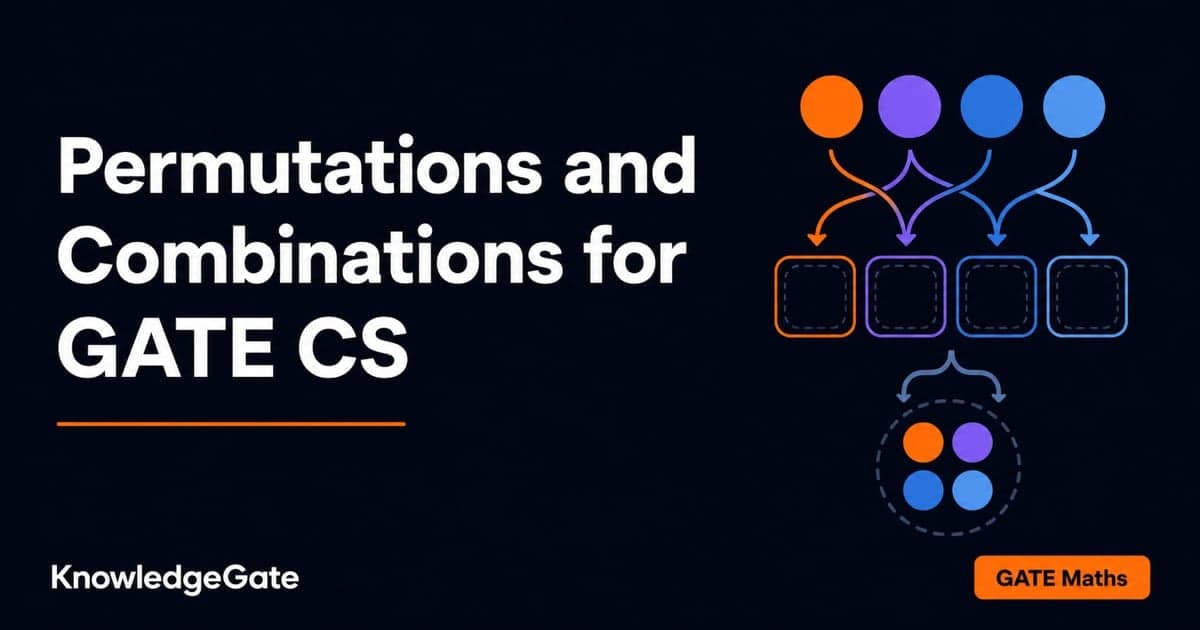
Most aspirants prepare permutations and combinations by memorising a sheet of formulas, then freeze when a GATE question matches none of them. The problem is not the formulas. Counting questions are decision problems, and you need a decision procedure, not a lookup table.
The procedure is four questions you put to the problem statement, and three moves, choose, arrange and subtract, that the answers select. A password count, a one-to-one function count and a handshake count are then the same small set of moves in different clothing.
Related reading: Circular permutations and Counting bijective functions.
Permutations and combinations: why one method beats twenty formulas
Every counting question asks how many ways a task can be completed. The task breaks into stages, and the subject reduces to three moves.
Choose. Pick r objects out of n when order does not matter: C(n, r) = n! / (r! (n - r)!). A committee, a subset.
Arrange. Put k distinct objects in order: k!. Arranging r objects picked from n gives P(n, r) = C(n, r) × r!, so a permutation is literally a choice followed by an arrangement.
Subtract. When the question says "at least one" or "never together", count the total, count the violating cases, and subtract. The complement is almost always easier to count.
Every standard formula is one of these moves, or two multiplied together. Seen that way, the formula sheet becomes receipts, not memory work.
The decision procedure to run before every counting question
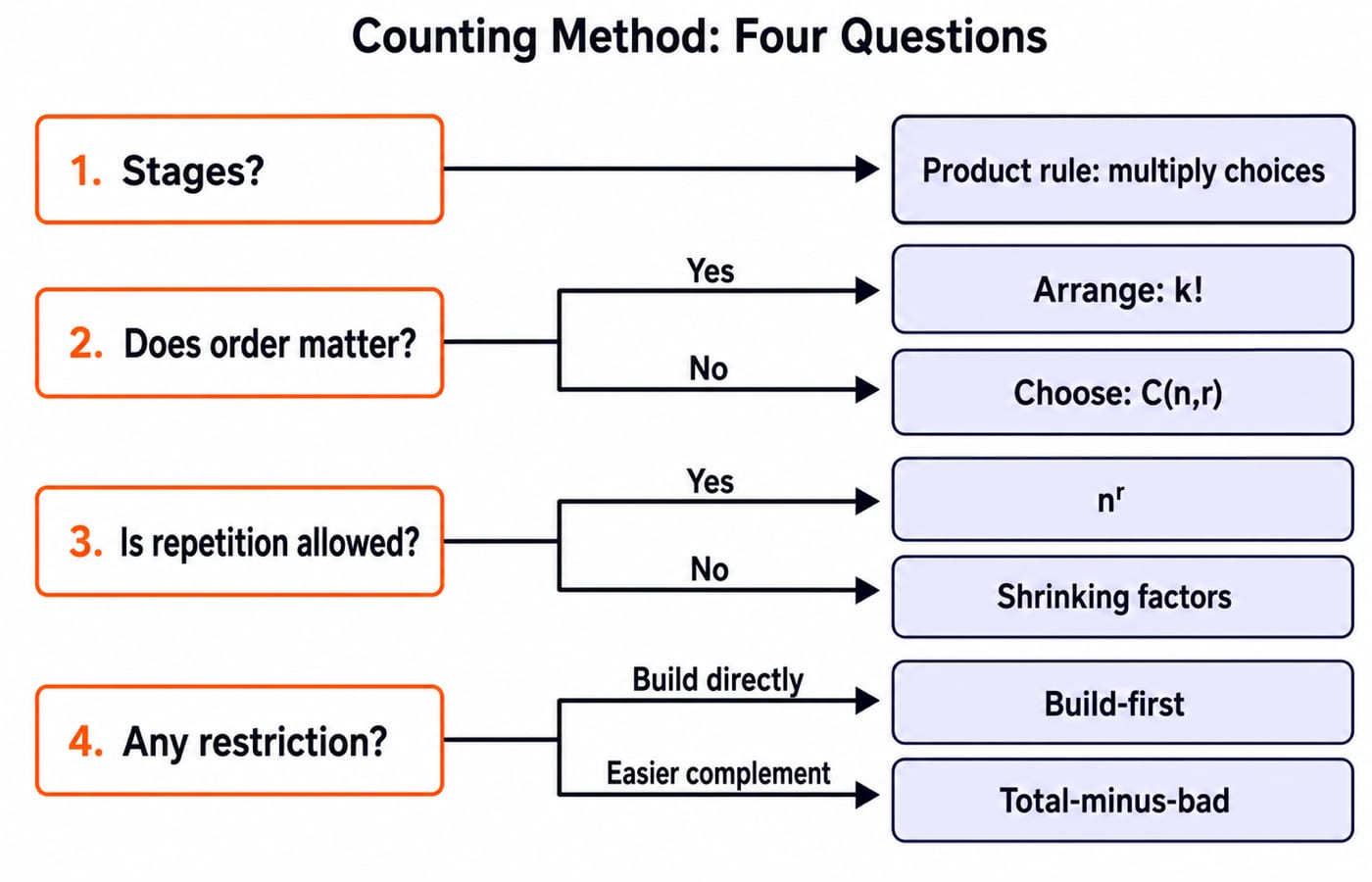
Run these four questions, in this order, on every problem.
What are the stages? Split the task into independent decisions and multiply their counts. This is the product rule.
Does order matter? Distinguishable slots or a sequence: arrange. A group where shuffling changes nothing: choose.
Is repetition allowed? Repeats mean every slot keeps all n options, so n^r. No repeats means shrinking options, so factorials.
Is there a restriction? Build the restricted part first, or count everything and subtract the violations, whichever is smaller.
Product rule problems: multiply the stages (Problems 1 to 5)
Problem 1. How many passwords have 3 lowercase letters followed by 2 digits? Five independent slots: 26 × 26 × 26 × 10 × 10 = 1,757,600.
Problem 2. How many binary strings of length 8 exist? Each position independently picks 0 or 1, so 2^8 = 256.
Problem 3. How many functions exist from a set A with 3 elements to a set B with 5 elements? Each element of A independently chooses an image in B: 5^3 = 125.
Problem 4. How many of those functions are one-to-one? Repetition is now banned, so options shrink: 5 × 4 × 3 = 60, exactly P(5, 3).
Problem 5. How many 3-digit even numbers have all distinct digits? Build the constrained slot first. Last digit 0: 9 × 8 = 72. Last digit 2, 4, 6 or 8: the first digit has 8 options (not zero, not the last digit), the middle has 8, so 4 × 8 × 8 = 256. Total 328.
Permutation problems: arrange when order matters (Problems 6 to 10)
Problem 6. In how many ways can 6 distinct books be placed in a row on a shelf? Arrange all six: 6! = 720.
Problem 7. How many 4-letter strings over the English alphabet have no repeated letter? Shrinking options: 26 × 25 × 24 × 23 = 358,800, i.e. P(26, 4).
Problem 8. How many distinct arrangements does the word ENGINE have? Six letters, E twice, N twice. Arrange all, divide out the shuffles of identical letters: 6! / (2! × 2!) = 180.
Problem 9. In how many ways can 7 people sit around a circular table? Fix one person to kill the rotations, arrange the rest: (7 - 1)! = 720.
Problem 10. In how many ways can 5 boys and 5 girls sit in a row, alternating? The pattern starts with a boy or a girl (2 ways); arrange boys in their seats and girls in theirs: 2 × 5! × 5! = 28,800.
Combination problems: choose when order does not matter (Problems 11 to 15)
Problem 11. How many 3-member committees can be formed from 10 people? A committee has no order: C(10, 3) = 120.
Problem 12. If 12 people all shake hands once, how many handshakes happen? Each handshake is an unordered pair: C(12, 2) = 66, the same count as edges in a complete graph on 12 vertices.
Problem 13. How many binary strings of length 10 contain exactly three 1s? Choosing which 3 positions hold the 1s fully determines the string: C(10, 3) = 120.
Problem 14. How many non-negative integer solutions does x + y + z = 10 have? Line up 10 identical units and 2 dividers and choose where the 2 dividers go: C(12, 2) = 66. Stars and bars is a choose move.
Problem 15. From 4 vowels and 5 consonants, how many ways can you select 2 vowels and 3 consonants? Two independent choices multiplied: C(4, 2) × C(5, 3) = 6 × 10 = 60.
Choose then arrange: the compound count GATE actually asks (Problems 16 to 18)
Problem 16. Continue Problem 15: how many 5-letter words can be formed from those selections? Choose gave 60 letter sets; arrange each set of 5 distinct letters: 60 × 5! = 7,200. Stopping after the choose step is the most common trap in the topic.
Problem 17. A committee of 5 is formed from 6 men and 4 women with exactly 2 women. Choose the women, choose the men: C(4, 2) × C(6, 3) = 6 × 20 = 120. No arrange step, a committee is unordered.
Problem 18. From 8 students, in how many ways can you pick 3 and seat them in a row of 3 chairs? Choose then arrange: C(8, 3) × 3! = 56 × 6 = 336, equal to P(8, 3). That is the receipt for the P(n, r) formula itself.
Subtract: complement counting for "at least" and "never" (Problems 19 and 20)
Problem 19. How many binary strings of length 8 contain at least one 1? Total minus the all-zero string: 2^8 - 1 = 255. One subtraction replaces eight cases.
Problem 20. How many 5-person committees from 6 men and 4 women contain at least one woman? Total minus all-male committees: C(10, 5) - C(6, 5) = 252 - 6 = 246. Direct counting needs four cases; the complement, one.
The same move handles "never together". Seat 7 people in a row so that two named people are never adjacent: glue the pair into one block, count the together cases as 6! × 2 = 1,440, and subtract from the total, 7! - 1,440 = 5,040 - 1,440 = 3,600.
Permutations and combinations in the GATE CS paper: where counting shows up
In GATE CS, combinatorics sits inside the Engineering Mathematics portion of the syllabus, and it rarely stays there. Counting leaks into the core subjects: functions and relations in discrete mathematics, edges and labelled graphs in graph theory, strings of a given length in automata questions. All of them reduce to the patterns above.
Many counting questions appear as NAT (numerical answer type), where you key in an integer with no options to eliminate. A half-trusted formula is dangerous there; a re-derivable procedure is not. For the exact section weightage in your cycle, check the official GATE information brochure, and for how Engineering Mathematics stacks up against the core subjects see our GATE CS subject-wise weightage breakdown. The current official GATE portal is the source for that cycle's brochure and paper rules.
The short version, and where to practise
Run the four questions on every problem: stages, order, repetition, restriction. Then execute choose, arrange, subtract as the answers dictate. No step in that loop asks you to recall a formula, which is why it survives a variant you have never seen before. Drill until the decision step is automatic.
Work the topic on the Permutation and Combination learn module, over 80 lessons inside the Engineering Mathematics track, backed by more than 300 permutation and combination questions in our question bank.
For the full syllabus with this sequencing built in, GATE Guidance by Sanchit Sir plans practice around a target score, flags syllabus hotspots, and tracks topic-wise performance.
Still comparing options? Start from the GATE category page.
Learn the three moves, run the four questions, and counting stops being a formula lottery and becomes the most predictable marks in the mathematics section.
Keep learning
One-to-One (Injective) Function: Definition, Counting Formula, Properties and Worked Examples
Learn how to identify and count injective functions, handle common restrictions, and prove their key composition and inverse properties with clear examples.
Updated 24 Oct 20266 min readEngineering Mathematics
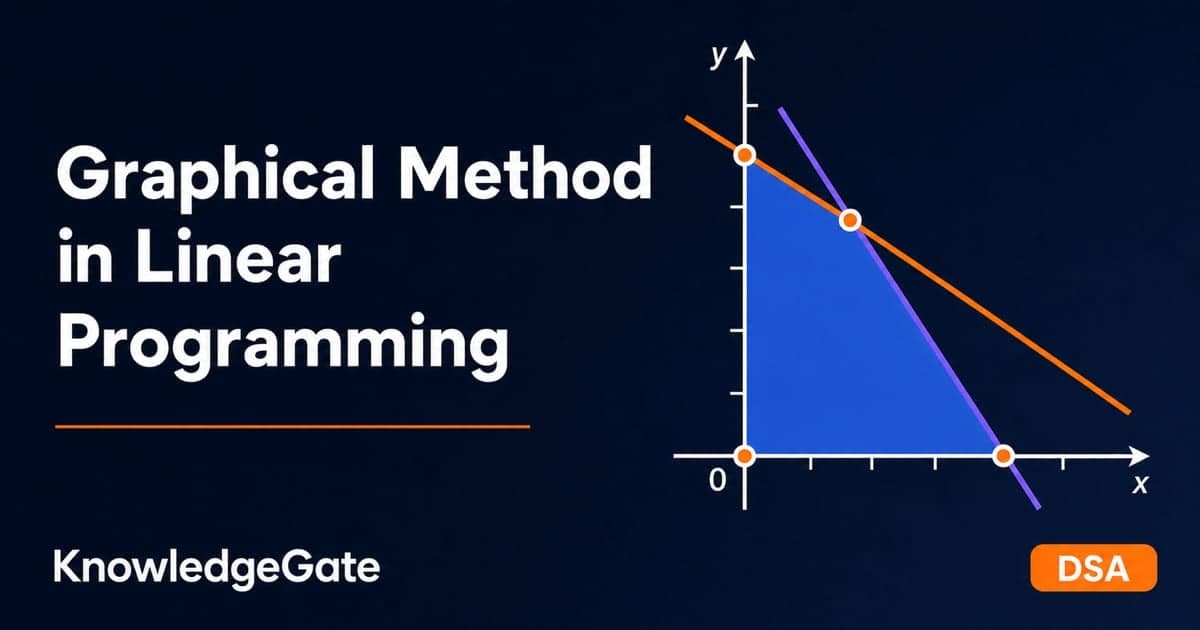
Graphical Method in Linear Programming: Feasible Region, Corner Points and Optimality with a Worked Example
Learn the two-variable graphical method in the right order, then solve and audit a complete maximisation model without trusting the sketch alone.
Updated 21 Oct 20265 min readEngineering Mathematics

Duality in LP: Construct the Dual, Solve a Worked Example, and Apply Key Properties
Learn a reliable matrix-first method to form an LP dual, solve both programs to value 21, and use duality properties to check optimality and avoid sign errors.
Updated 17 Oct 20266 min readEngineering Mathematics
Commutative Property and Abelian Groups: Tests, Worked Examples and Exam Traps
Learn how to separate commutativity from the other group axioms, test custom operations step by step, and avoid the usual classification traps.
Updated 13 Oct 20266 min readEngineering Mathematics