Post-Independence Education Policy for Teaching Exams: Commissions, Policies and Worked Examples
Separate commissions, statutory bodies, policies and action plans before memorising the dates. These notes include a worked match, trap repairs and a 16-card revision loop.
KnowledgeGate Team
Exam prep & CS education
Updated 29 Aug 20265 min read

Aspirants remember 1948, 1968, 1986, 1992 and 2020, then confuse a commission with a policy or UGC's inauguration with statutory establishment. Attach every date to a body, scope and document type. Check your exam's official syllabus.
First classify the item: commission, body, policy or action plan
A commission recommends changes. A statutory body continues under law. A policy states direction; a programme of action sets implementation priorities. A current bulletin governs an exam cycle, not policy history.
Anchor | Type | Scope or role |
|---|---|---|
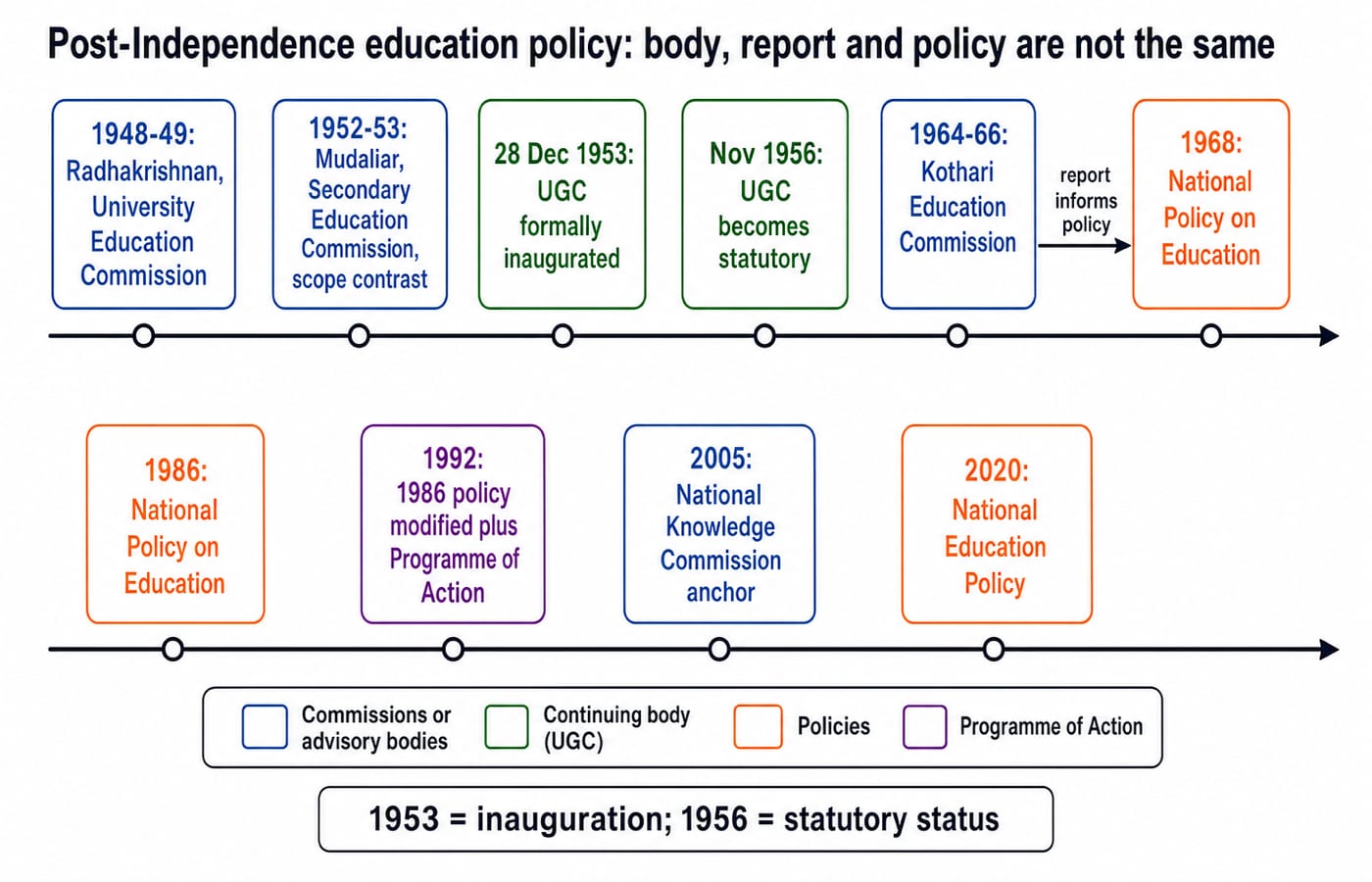
University Education Commission, 1948 | Commission | Indian university education |
UGC, inaugurated 28 December 1953 and made statutory in November 1956 | Body | Coordination and standards in university education |
National Policy on Education, 1968 | Policy | National direction |
National Policy on Education, 1986 as modified in 1992 | Policy | National direction with later modification |
Programme of Action, 1992 | Implementation document | Implementation priorities |
National Education Policy, 2020 | Policy | Later national direction |
Record each entry as year or span | chair or body | education level | document type | one durable contribution. Use UGC NET Paper 1 vs Paper 2 to separate the common and subject papers, not as historical authority.
Radhakrishnan Commission and the three UGC dates
UGC Genesis records that the University Education Commission was set up in 1948 under Dr S. Radhakrishnan to examine Indian university education. Store Radhakrishnan = university education, not merely education.
In 1952, the Union Government decided that relevant grant-in-aid cases might be referred to UGC. UGC was formally inaugurated on 28 December 1953 and became statutory through an Act of Parliament in November 1956. Thus, 1953 = formal inauguration; 1956 = statutory establishment.
Try this original statement pair:
Statement I: UGC was formally inaugurated on 28 December 1953.
Statement II: UGC became a statutory body in November 1956.
Options: (A) both are correct; (B) only I is correct; (C) only II is correct; (D) both are incorrect.
Answer (A). The events differ.
Mudaliar and Kothari: use scope to stop name swapping
Commission | Years | Scope |
|---|---|---|
Radhakrishnan | 1948-49 | University education |
Mudaliar | 1952-53 | Secondary education |
Kothari | 1964-66 | Education as a system |
Filter by scope first: universities suggest Radhakrishnan, secondary education suggests Mudaliar, and a system-wide review suggests Kothari. Chairperson, title, year and level may become separate matching columns.
The Kothari report informed the National Policy on Education, 1968, as recorded on the Ministry of Education's NPE 1968 page. Store commission report informs policy. The commission was not the policy, and not every recommendation necessarily became policy.
Read the national-policy sequence without collapsing 1986 and 1992
Preserve NPE 1968 -> NPE 1986 -> NPE 1986 as modified in 1992 -> NEP 2020. NPE and NEP are not interchangeable.
Year | Official anchor | Type | Reading rule |
|---|---|---|---|
1968 | National Policy on Education | Policy | First national-policy anchor in this sequence |
1986 | National Policy on Education | Policy | New policy framework |
1992 | Modification plus Programme of Action | Revision and implementation | Not a separate Act |
2020 | National Education Policy | Policy | Later national-policy anchor |
The Ministry's title is National Policy on Education, 1986 (as modified in 1992), as shown on the Ministry of Education's NPE 1986 page. Policy gives direction; the Programme of Action covers implementation. NPE 1992 is not separate, and the Programme is not an Act.
Place later reform bodies and NEP 2020 on the same map
The NITI Aayog higher-education policy report places the National Knowledge Commission at the 2005 reform anchor and describes it as an advisory body. It was not another National Education Policy.
NEP 2020, as presented on the Ministry of Education's NEP 2020 page, is the later policy document. Its higher-education direction includes multidisciplinary learning, flexibility, access, equity, quality, research and institutional reform. Across documents, concerns recur but institutions and mechanisms change. Direction is not completed implementation, so check current status before claiming an outcome.
Worked example: match four bodies or documents
Use this practice item to learn the matching method; it carries no exam or year attribution.
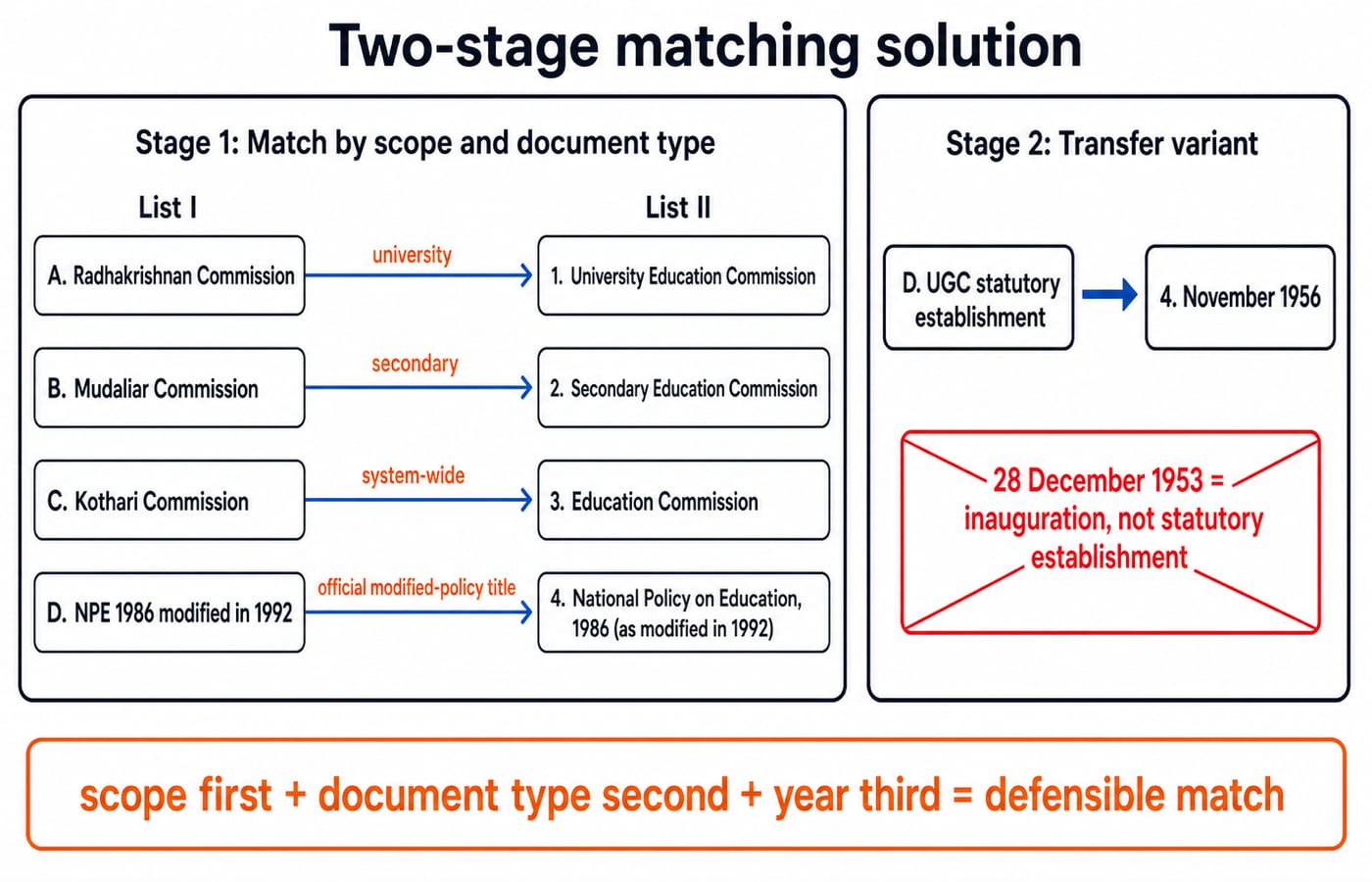
List I: (A) University Education Commission; (B) Secondary Education Commission; (C) Education Commission; (D) National Policy on Education as modified in 1992.
List II: (1) Radhakrishnan, 1948-49, university education; (2) Mudaliar, 1952-53, secondary education; (3) Kothari, 1964-66, system-wide education review; (4) 1986 policy with 1992 modifications.
Options: (i) A-1, B-2, C-3, D-4; (ii) A-2, B-1, C-4, D-3; (iii) A-3, B-4, C-1, D-2; (iv) A-4, B-3, C-2, D-1.
Solve in four passes:
University Education -> Radhakrishnan -> 1948-49, so A-1.Secondary Education -> Mudaliar -> 1952-53, so B-2.Education Commission -> Kothari -> 1964-66, so C-3.The modified-policy title gives D-4.
Therefore (i) is correct. Scope and document type can recover a forgotten date.
In a transfer variant, replace D with UGC statutory establishment and item 4 with November 1956. The answer remains A-1, B-2, C-3, D-4. The 1953 date is wrong here because it names inauguration.
How teaching exams turn this history into questions
Practise five forms: year-person matching, commission-title matching, chronological order, statement pairs such as 1953 versus 1956, and scope-based elimination. Add a one-line reason to every answer.
Trap | What goes wrong | Repair |
|---|---|---|
| One UGC date replaces both events | Store the event label with each date |
| Modification and implementation collapse | Write |
| Report and policy merge | Use |
| Names are swapped | Attach the word |
| Direction becomes outcome | Check present status in official sources |
UGC NET common mistakes uses the same repair: identify the cause, then rewrite the anchor. CTET, State TETs, UGC NET and recruitment papers do not share one pattern. Verify current UGC NET rules on the official UGC NET site.
The short version and a 16-card revision loop
Radhakrishnan: university education, 1948-49.
Mudaliar: secondary education, 1952-53.
Kothari: system-wide commission, 1964-66.
UGC: 1953 inauguration, 1956 statutory status.
NPE: 1968, then 1986 as modified in 1992.
NEP: 2020.
National Knowledge Commission: advisory reform body, not national policy.
Build 16 cards: 6 person or body, 4 scope, 4 document-type and 2 UGC event cards. Attempt them chronologically, then shuffled, then retest errors plus two neighbouring anchors.
With 13 correct, 2 wrong and 1 unattempted, attempted cards are 13 + 2 = 15. Accuracy is 13 / 15 x 100 = 86.666...%, or 86.7%. Yet 2 + 1 = 3 cards remain unresolved. Label each name error, scope error, event-date error or document-type error, then rebuild its anchor.
Use topic practice to test commission, date, scope and document-type distinctions. Treat an item as a previous-year question only when it names an exam and year. Continue with the NTA UGC NET Paper 1 course, use the UGC NET Paper 1 test series for timed practice, and explore the NET category.
Now redraw the timeline, solve the four-pair item, and verify missed years against official sources.
Keep learning

Guidance, Counselling and Mental Health for Teaching Exams: Concepts, Cases and Exam Traps
Learn to separate guidance, counselling and mental-health support, then apply the distinctions to learner cases without crossing a teacher's professional boundaries.
Updated 23 Oct 20266 min readCTET & UPTET

Classroom Management and Communication for Teaching Exams: Complete Notes and Worked Scenarios
Connect classroom management, communication, feedback, discipline, and teacher immediacy, then practise an exam-style vignette with a step-by-step solution.
Updated 19 Oct 20266 min readCTET & UPTET

Teaching-Learning Aids and ICT Integration for Teaching Exams: Notes with Worked Classroom Examples
Learn how to select and sequence teaching-learning aids, recognise genuine ICT integration, and solve classroom scenarios with worked calculations.
Updated 15 Oct 20265 min readCTET & UPTET

Nature, Objectives and Characteristics of Teaching: Concept Notes for Teaching Exams
Learn to separate what teaching is, what change it seeks and how an effective teaching process operates. A worked fraction lesson connects every concept.
Updated 10 Oct 20265 min readCTET & UPTET