Pre-Independence Education Commissions for Teaching Exams: Timeline and Key Recommendations
Separate minutes, despatches, commissions, Acts and plans before memorising the dates. This guide builds the full timeline and solves a seven-item match.
KnowledgeGate Team
Exam prep & CS education
Updated 31 Aug 20265 min read60 views
The difficult part is not one date. It is separating people, reports, Acts and recommendations when a matching question mixes them together. Macaulay's Minute, Wood's Despatch, the Hunter and Raleigh commissions, the Indian Universities Act, the Sadler Commission, the Hartog Committee and the Sargent Plan are different kinds of instruments. For UGC NET aspirants, UGC NET Paper 1 vs Paper 2 for Computer Science: what each tests and how to split your prep locates Higher Education within Paper 1.
1. First classify the education measure
British-era measures up to 1947 are commonly grouped in objective papers. Before learning a recommendation, label the item correctly.
Type | Examples |
|---|---|
Minute | Macaulay's Minute, 1835 |
Despatch | Wood's Despatch, 1854 |
Commission or committee | Hunter, 1882; Raleigh, 1902; Sadler, 1917-1919; Hartog, 1929 |
Conference | Shimla Education Conference, 1901 |
Act | Indian Universities Act, 1904 |
Board or plan | CABE, first established 1920; Sargent Plan, 1944 |
The first trap rule is simple: Wood's Despatch is not an Act, and Sadler is not a post-Independence commission. Use UGC NET Preparation Courses & Test Series for broader preparation, but do not assume that every teaching exam follows the same syllabus.
2. Build the chronology around seven anchor years
Memorise one seven-number spine:
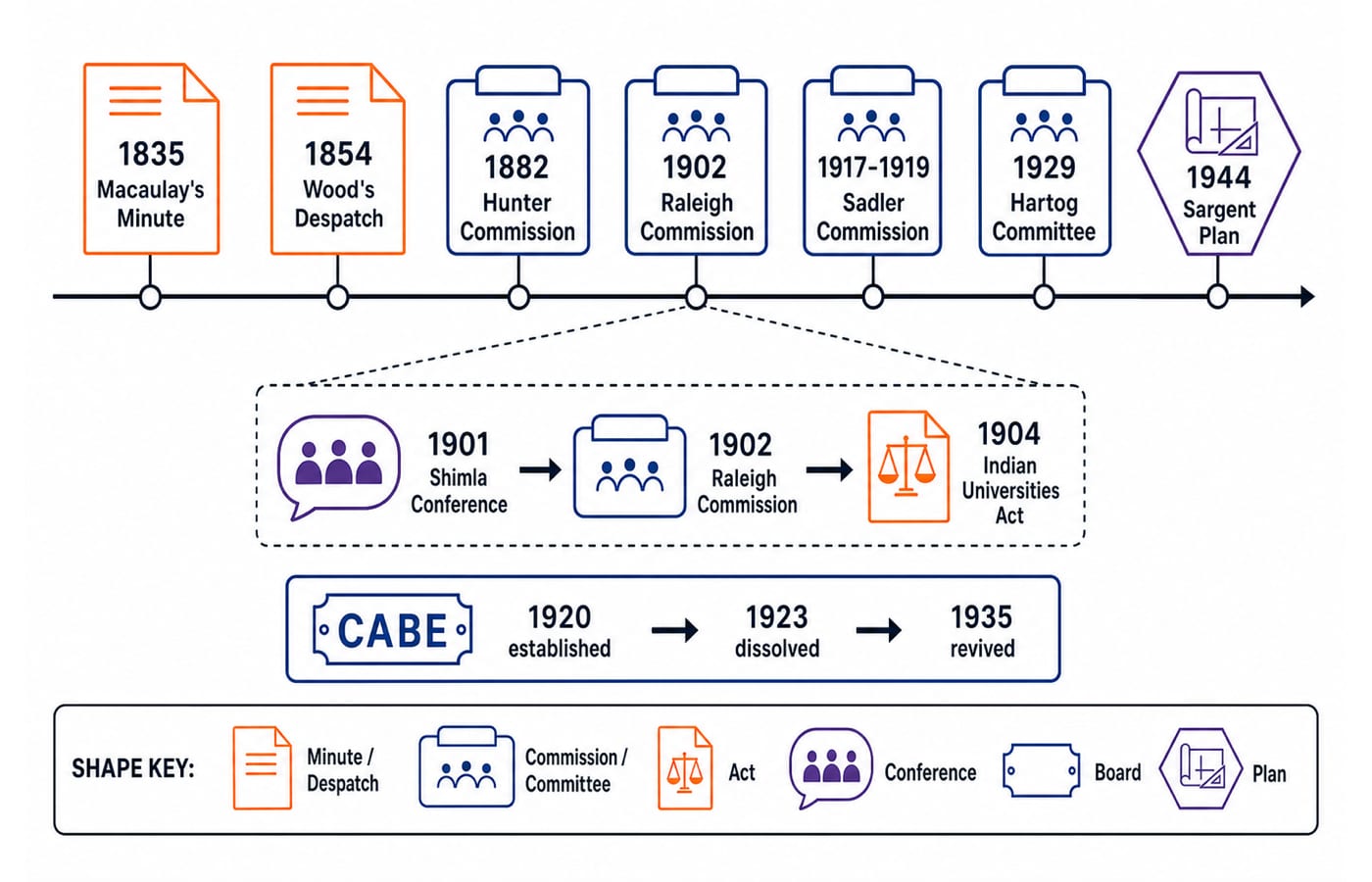
1835 -> 1854 -> 1882 -> 1902 -> 1917 -> 1929 -> 1944
Attach Macaulay, Wood, Hunter, Raleigh, Sadler, Hartog and Sargent. Then insert the university-reform chain 1901 -> 1902 -> 1904: Shimla Education Conference, Raleigh Commission, Indian Universities Act.
CABE forms a side branch. The Ministry of Education records that it was first established in 1920, dissolved in 1923 and revived in 1935. Use those official values, not the looser 1921 date found in some notes.
3. Macaulay in 1835 and Wood in 1854: direction versus system
Macaulay's Minute of 1835 was a policy argument associated with English and European learning. Wood's Despatch of 1854 was broader and system-building. It is associated with an articulated education structure, education departments, grants-in-aid, teacher training and universities.
The UGC's Genesis account records Macaulay's 1835 advocacy, describes Wood's Despatch as an articulated scheme from primary school to university, and places the universities of Calcutta, Bombay and Madras in 1857.
Use the values as a check. English or European learning + 1835 points to Macaulay. Organised framework + 1854 points to Wood. Do not replace Wood's year with 1857. That later value belongs to the establishment of the three universities in the UGC account.
4. Hunter, Shimla and Raleigh: follow the narrowing focus
The Hunter Commission of 1882 reviewed primary and secondary education. Its distinguishing recommendations were to transfer control of primary education to district and municipal boards, and to divide secondary schooling into literary and practical or vocational streams. The combination of local bodies and two secondary streams separates Hunter from the university-reform sequence that followed.
That sequence has three steps:
Shimla Education Conference,
1901Raleigh or Indian Universities Commission,
1902Indian Universities Act,
1904
The numerical gaps are 1902 - 1901 = 1 year and 1904 - 1902 = 2 years. The subject also narrows across the sequence. The 1901 Shimla conference considered education from primary school to university and led into the Indian Universities Commission. Raleigh in 1902 focused on university administration, college supervision and affiliation conditions; the 1904 Act followed. Therefore, Raleigh = 1902, not 1904. The Indian Universities Act is an Act, not a commission.
5. Sadler, CABE, Hartog and Sargent: the 1917-1944 arc
The Sadler Commission is also called the Calcutta University Commission, 1917-1919. It recommended placing the dividing line between secondary and university study after the intermediate examination, creating intermediate colleges, and establishing a Board of Secondary and Intermediate Education. These recommendations connect school, intermediate and university stages, so Sadler is not only a fact about one campus.
CABE is the institutional branch, not another commission. The Calcutta University Commission proposed a central advisory board; CABE was established in 1920, dissolved in 1923, and revived in 1935.
Hartog Committee, 1929, prioritised consolidation and quality in primary education, especially the problems of wastage and stagnation, rather than rapid expansion. Sargent Plan, 1944, proposed universal, free and compulsory education for ages 6 to 14 and academic and technical secondary paths. The UGC account describes it as the first attempt at a national system and records the University Grants Committee formed in 1945.
Sadler reorganises the transition into university, CABE advises governments, Hartog diagnoses quality and retention problems, and Sargent designs a national system. Those verbs are the recommendation-level distinctions to recall after the dates.
6. Fully worked matching example
Match Column A with Column B. Which code is correct?
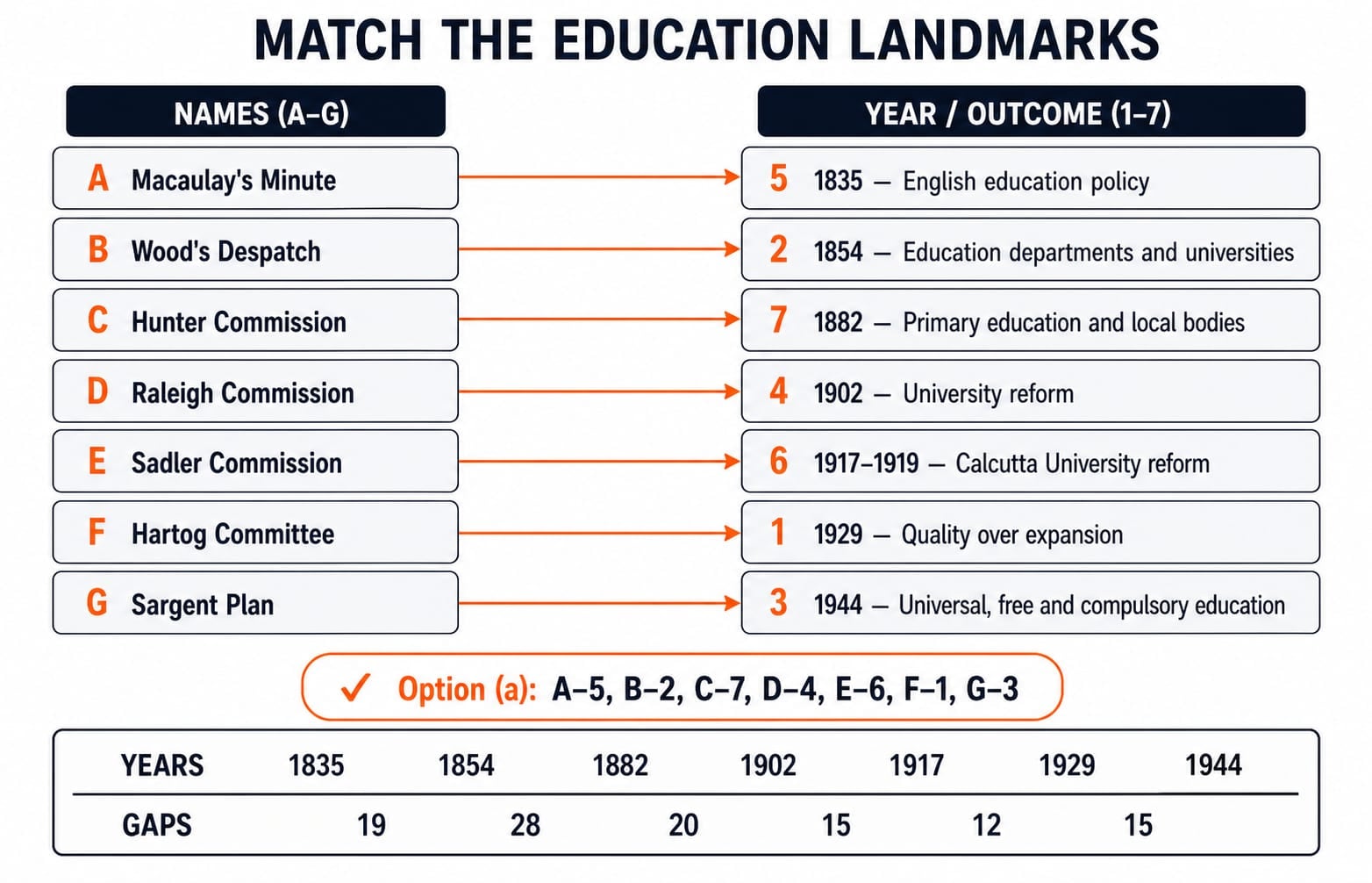
Column A: A. Macaulay's Minute; B. Wood's Despatch; C. Hunter Commission; D. Raleigh Commission; E. Sadler Commission; F. Hartog Committee; G. Sargent Plan.
Column B: 1. 1929, quality/wastage/stagnation; 2. 1854, organised education framework; 3. 1944, post-war national plan; 4. 1902, university inquiry/reform; 5. 1835, English and European learning; 6. 1917-1919, Calcutta University and intermediate-stage questions; 7. 1882, primary/secondary education.
(a) A-5, B-2, C-7, D-4, E-6, F-1, G-3(b) A-2, B-5, C-4, D-7, E-1, F-6, G-3(c) A-5, B-2, C-7, D-6, E-4, F-1, G-3(d) A-5, B-7, C-2, D-4, E-6, F-3, G-1
First lock A-5 from 1835 and B-2 from 1854. Next, Hunter's primary/secondary association gives C-7. Separate Raleigh 1902, so D-4, from Sadler 1917-1919, so E-6. Hartog 1929 gives F-1, and Sargent 1944 gives G-3. The correct answer is (a).
Now sort the start years: [1835, 1854, 1882, 1902, 1917, 1929, 1944]. Their consecutive gaps are [19, 28, 20, 15, 12, 15]. A swapped pair will break this ordered check.
7. Traps used in teaching-exam questions
Every item is a commission-> classify the document first.Wood = 1857-> Wood is 1854; the three universities followed in 1857.Raleigh = 1904-> Raleigh is 1902; the Act is 1904.Sadler is only higher education-> it examined the school, intermediate and university connection.CABE = 1921-> the official Ministry history gives 1920.Hartog and Sargent are swapped-> Hartog diagnoses quality and wastage in 1929; Sargent is the 1944 post-war plan.Radhakrishnan belongs here-> the 1948-1949 commission is post-Independence.
Expect chronology, match-the-following, person/report aliases, year-document pairs and statement combinations, not a guaranteed fixed weight. Radhakrishnan begins the post-Independence commission sequence in 1948, so keep that later timeline separate from this colonial-era chain.
8. Short version and next step
Recall 1835 Macaulay, 1854 Wood, 1882 Hunter, 1902 Raleigh, 1917-1919 Sadler, 1929 Hartog, 1944 Sargent. Add 1901 -> 1902 -> 1904 for Shimla, Raleigh and the Act, plus 1920 -> 1923 -> 1935 for CABE.
Redraw the timeline from memory, solve 10 mixed chronology and matching questions, and log each error as year, document type, body alias or recommendation. Use NTA UGC NET Paper 1 Course for structured learning, then the UGC NET Paper 1 Test Series for timed practice.
Keep learning

Guidance, Counselling and Mental Health for Teaching Exams: Concepts, Cases and Exam Traps
Learn to separate guidance, counselling and mental-health support, then apply the distinctions to learner cases without crossing a teacher's professional boundaries.
Updated 23 Oct 20266 min readCTET & UPTET
Classroom Management and Communication for Teaching Exams: Complete Notes and Worked Scenarios
Connect classroom management, communication, feedback, discipline, and teacher immediacy, then practise an exam-style vignette with a step-by-step solution.
Updated 19 Oct 20266 min readCTET & UPTET

Teaching-Learning Aids and ICT Integration for Teaching Exams: Notes with Worked Classroom Examples
Learn how to select and sequence teaching-learning aids, recognise genuine ICT integration, and solve classroom scenarios with worked calculations.
Updated 15 Oct 20265 min readCTET & UPTET
Nature, Objectives and Characteristics of Teaching: Concept Notes for Teaching Exams
Learn to separate what teaching is, what change it seeks and how an effective teaching process operates. A worked fraction lesson connects every concept.
Updated 10 Oct 20265 min readCTET & UPTET