TCS Ignite vs TCS NQT vs Smart Hiring: Which TCS Track Should You Apply Through?
TCS has different entry doors for different graduate profiles. Compare NQT, Ignite and Smart Hiring by degree, timing and journey before choosing your preparation route.
KnowledgeGate Team
Exam prep & CS education
Updated 27 Jul 20265 min read98 views
TCS runs more than one entry door for freshers. Students sometimes prepare for the best-known test, then discover that their degree or graduating cohort belongs to a different hiring track.
NQT, Ignite and Smart Hiring are aimed at different candidate situations. Pick by degree, timeline and desired journey before you prepare a single question. “Which is easier?” is the wrong first question.
TCS NQT, the mainstream hiring funnel
The TCS National Qualifier Test is the standardised assessment route most graduates associate with TCS fresher hiring. It commonly combines aptitude, verbal ability, programming logic and coding, then uses performance and the active drive's rules to move eligible candidates through the hiring process.
Candidates often discuss the resulting mainstream hiring bands as Ninja and the higher Digital or Prime opportunities. Those names describe the route and performance conversation, but they do not give every applicant automatic eligibility for every band. The current drive decides who may apply and how candidates progress.
NQT is usually the natural starting point for engineering graduates and other degree streams included in the active mainstream drive. It also appears in both campus and off-campus preparation conversations because it is the broad funnel most TCS aspirants recognise.
Percentage rules, backlog conditions and graduating-year windows are set drive by drive, so read them off the active TCS careers listing rather than last year's version of it. For a section-level orientation before you get there, read the TCS NQT exam structure.
TCS Ignite, the train-then-hire route
TCS Ignite is built around non-engineering science graduates, commonly from BSc, BCA and similar eligible streams. Its distinctive idea is not merely a different test label. It is a learning-then-employment journey in which candidates are selected into a software-skilling path and prepared for technology work.
That makes Ignite different from treating NQT as a direct coding contest on day one. A candidate can enter with a science or computer-applications foundation and be assessed for the capacity to learn the software stack expected by the programme. Aptitude, logical thinking, communication and programming readiness still matter, but training is part of the route's identity.
Ignite therefore suits a candidate who:
comes from an eligible non-engineering science stream;
wants a structured transition into software work;
is prepared to learn consistently rather than only clear an assessment;
matches the current cohort rules announced by TCS.
Accepted degrees and academic conditions move with the cohort, so read “BSc or BCA” as the signpost for the route and the current cohort notice as the rule.
TCS Smart Hiring, the cohort-specific early drive
Smart Hiring is a targeted route that TCS can open for particular degree groups, graduating batches or early-hire pools. BCA, BSc and MCA candidates are often part of the conversation, but the live listing is what defines the cohort.
Its distinguishing feature is timing. Smart Hiring may run on its own schedule and close when that cohort's drive closes. It is not a permanent easier version of NQT. A candidate belongs to it because the advertised degree and batch match, not because they prefer a shorter route.
Because the timing is the point, watch TCS's own channels through your graduating cycle. A targeted drive can open outside the main preparation calendar and close before the next mainstream window comes around. Check that a registration page really is TCS's before you share personal information, since fake early-drive forms tend to circulate around exactly these announcements.
Which TCS track is actually yours?
Match your own situation to a first track before you compare question patterns:
Your situation | First track to check | Why |
|---|---|---|
Engineering graduate or another degree included in the mainstream drive | TCS NQT | It is the broad standardised hiring funnel |
Eligible non-engineering science graduate seeking a train-then-hire journey | TCS Ignite | Structured software learning is central to the route |
Candidate named by a targeted graduating-batch or early-drive notice | TCS Smart Hiring | The opening is cohort-specific and timing-driven |
There can be overlap. A science graduate may see both Ignite and a Smart Hiring drive, or an eligible candidate may encounter an NQT-based route in the same season. When that happens, compare the official eligibility, journey and role communication. Do not decide from a coaching label alone.
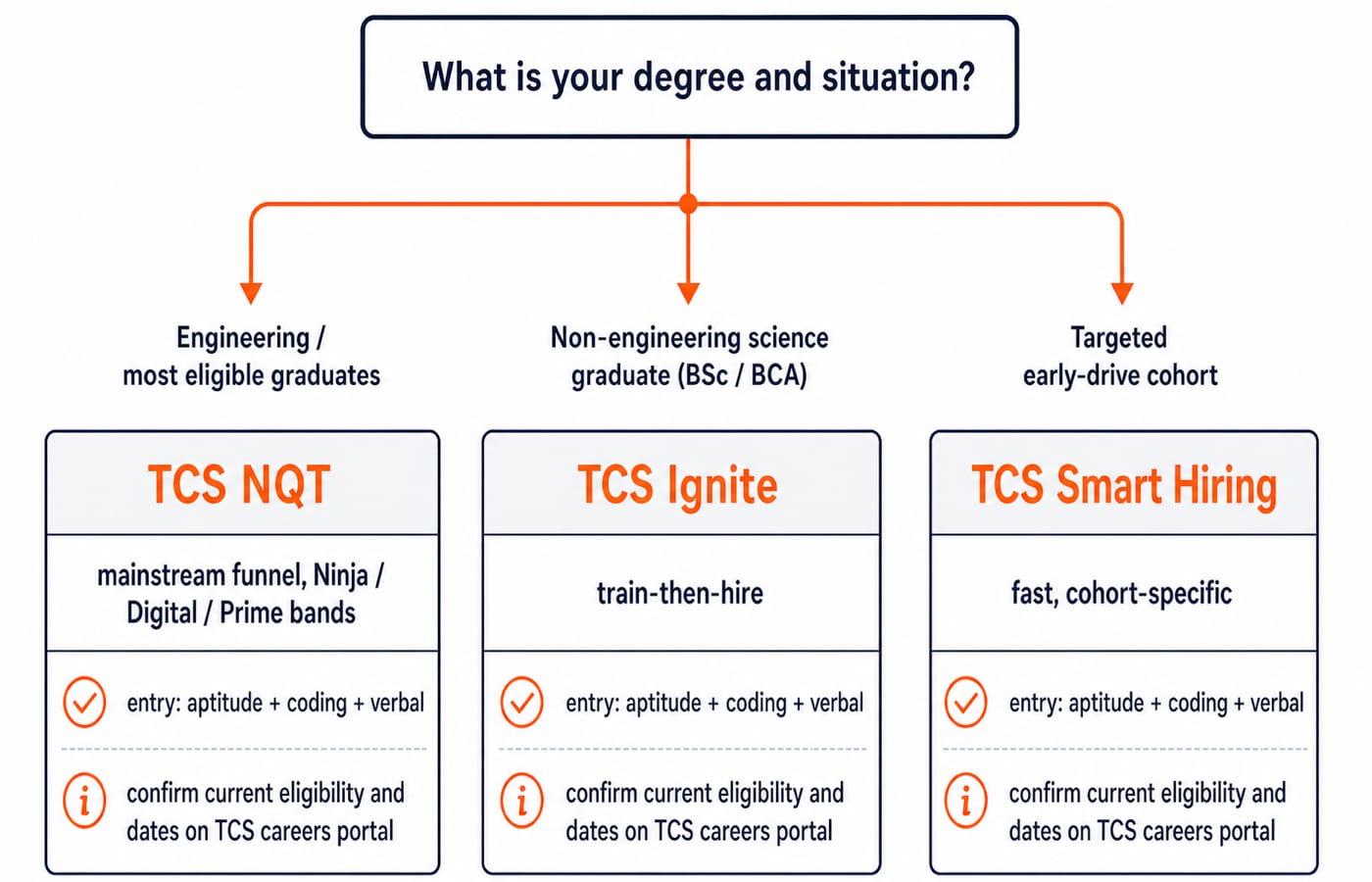
TCS test preparation: the shared base, and where the three tracks diverge
Across all three TCS assessments the reusable base is the same: quantitative aptitude, logical reasoning, verbal ability, programming logic and coding. What changes between tracks is how much weight each one carries and what the assessment is really deciding about you. Section names, counts and timings belong to the drive notice, but that underlying purpose is stable enough to prepare against.
Build the common base in this order:
Aptitude accuracy: learn the method before using a timer, then shorten your solution path.
Logical reasoning: recognise common series, arrangement and deduction structures.
Verbal clarity: practise grammar, comprehension and concise written reasoning.
Programming fundamentals: know variables, loops, functions, arrays, strings and basic complexity.
Coding execution: solve small problems with correct input, output and edge-case handling.
Only after that should you tune preparation to the active track, because the three pull in genuinely different directions. NQT is a competitive standardised sieve, so once the aptitude floor is cleared it is timed coding accuracy that separates one candidate from the next. Ignite selects you into training rather than into a role on day one, so breadth of fundamentals, communication and visible learning speed count for more than contest-style speed. Smart Hiring tests the same base under a cohort calendar you do not control, so the binding constraint is being ready on a fixed date rather than depth accumulated over months.
The broader TCS NQT preparation guide helps turn the mainstream route into a study plan. Even if your route is Ignite or Smart Hiring, much of that aptitude and programming foundation still transfers.
Before you apply and the short version
Eligibility, academic thresholds, section timings and dates are set fresh each TCS cycle, so confirm all of them on TCS's own careers portal before you register. A degree label points you at the likely door; only the live drive decides whether that door is open to you.
The short decision is simple. Engineering and most broadly eligible graduates start by checking NQT. Non-engineering science graduates seeking a training-led software route check Ignite. Candidates named by a targeted early-drive cohort check Smart Hiring. Degree and cohort pick the door, not perceived difficulty.
Prepare the shared foundation through the TCS Ignite and Smart Hiring course, then use the placement-preparation catalogue to strengthen aptitude, verbal ability and coding. When the active notice appears, tune that base to its exact requirements instead of restarting from zero.
Keep learning
Which Skill Sets Are in Demand for Tech Jobs?
Explore the technical and human skill combinations showing up across software, AI, data, cloud, and security roles—and how students can prove them with focused projects.
21 Oct 20265 min readPlacement Preparation
AI Is Changing Campus Hiring: How Students Can Show Their Skills
Make your technical skills visible in AI-assisted campus hiring with clear resume evidence, one explainable project, and a practical interview routine.
15 Oct 20265 min readPlacement Preparation
Resume Checklist: What Must Be Included and What Must Be Left Out
3 Oct 20264 min readPlacement Preparation
LDAP Explained: DNs, Bind, Search Filters, and a Developer Login Flow
Build one LDAP mental model from directory tree to login. Trace a service bind, escaped user search, password-verifying user bind, and group-based role check.
Updated 13 Aug 20265 min readPlacement Preparation