

CS Fundamentals
485 articles in this topic
Relations in Discrete Mathematics: Properties, Posets and Worked Examples
Build relations from Cartesian products, test their properties mechanically, and solve equivalence, partial-order, closure, and counting questions with exact examples.
Updated 6 Aug 20266 min read355 viewsEngineering Mathematics

Inter-Process Communication for GATE: Shared Memory, Message Passing and Pipes Compared
Learn who moves the data and who provides synchronization in each IPC model, then test the distinction through six carefully adjudicated statements.
Updated 6 Aug 20266 min read63 viewsOperating Systems
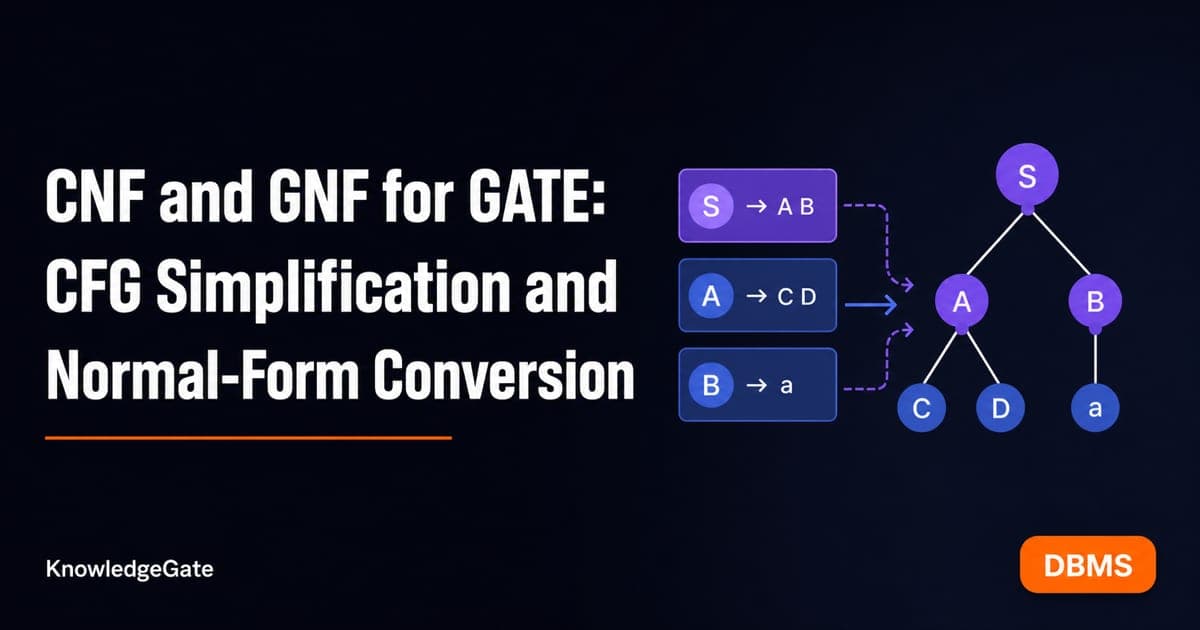
CNF and GNF for GATE: CFG Simplification and Normal-Form Conversion, Step by Step
Run epsilon, unit and useless-production removal in the right order, convert one full grammar to CNF, and verify the two derivation-count formulas.
Updated 6 Aug 20267 min read63 viewsDBMS
Theory of Computation (TOC): Complete Guide with Worked Examples
Connect the main ideas of TOC through worked examples, from alphabets and DFA traces to grammars, stacks, Turing machines and decidability.
Updated 6 Aug 20266 min read111 viewsTheory of Computation

Control Unit Design in COA: Hardwired vs Microprogrammed, with Worked Examples
Build control unit design from timed micro-operations. Work through a fetch and LOAD sequence, derive control signals, and size horizontal and vertical microcode.
Updated 4 Aug 20266 min readComputer Organization & Architecture
Digital Electronics for GATE: Official Syllabus Map, Weightage Logic and Prep Order
Turn the compact GATE CS Digital Logic syllabus into a practical study sequence, then learn how to audit past-paper weightage without treating it as a forecast.
Updated 4 Aug 20265 min readDigital Logic
C Programming by Yash Sir: Complete Guide with Worked Examples
Build C from evaluation rules to pointers with worked output traces, a recursion call stack, memory diagrams, common traps, and a clear route into exam and placement practice.
Updated 4 Aug 20267 min readC Programming & Data Structures

Data Link Layer Access Control: Medium Access Protocols with Worked Examples
Understand where access control sits inside the MAC sublayer, compare random, controlled and channelized access, and solve the ALOHA and CSMA/CD calculations students commonly mix up.
Updated 4 Aug 20266 min read56 viewsComputer Networks
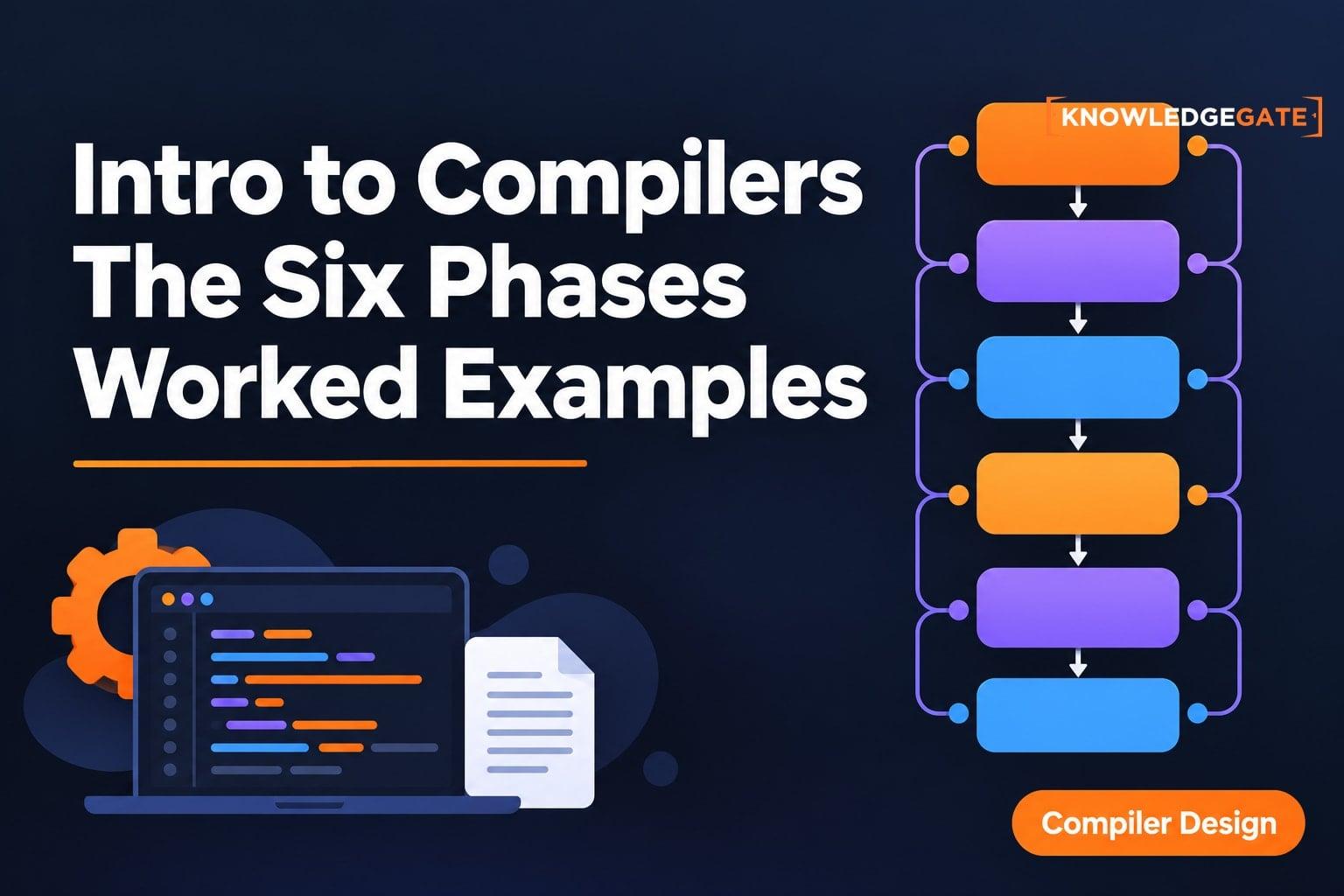
Intro to Compilers (Compiler Design): The Six Phases Traced with Worked Examples
Follow position = initial + rate * 60 through lexical, syntax and semantic analysis, intermediate code, optimisation, and target code. The worked trace turns six memorised phase names into one visible pipeline.
Updated 3 Aug 20265 min read200 viewsCompiler Design
Propositional and Predicate Logic in Discrete Mathematics: From Truth Tables to Quantifiers
Build logic from atomic propositions to nested quantifiers, with complete truth tables, canonical forms, countervaluations, and finite-domain checks.
Updated 3 Aug 20266 min read56 viewsEngineering Mathematics

Coal India MT Eligibility and Selection Process: What the Notification Actually Says
Use the current Coal India notification to verify your degree, percentage, age and selection route before you prepare for a CBT or depend on a GATE score.
Updated 3 Aug 20266 min readOperating Systems
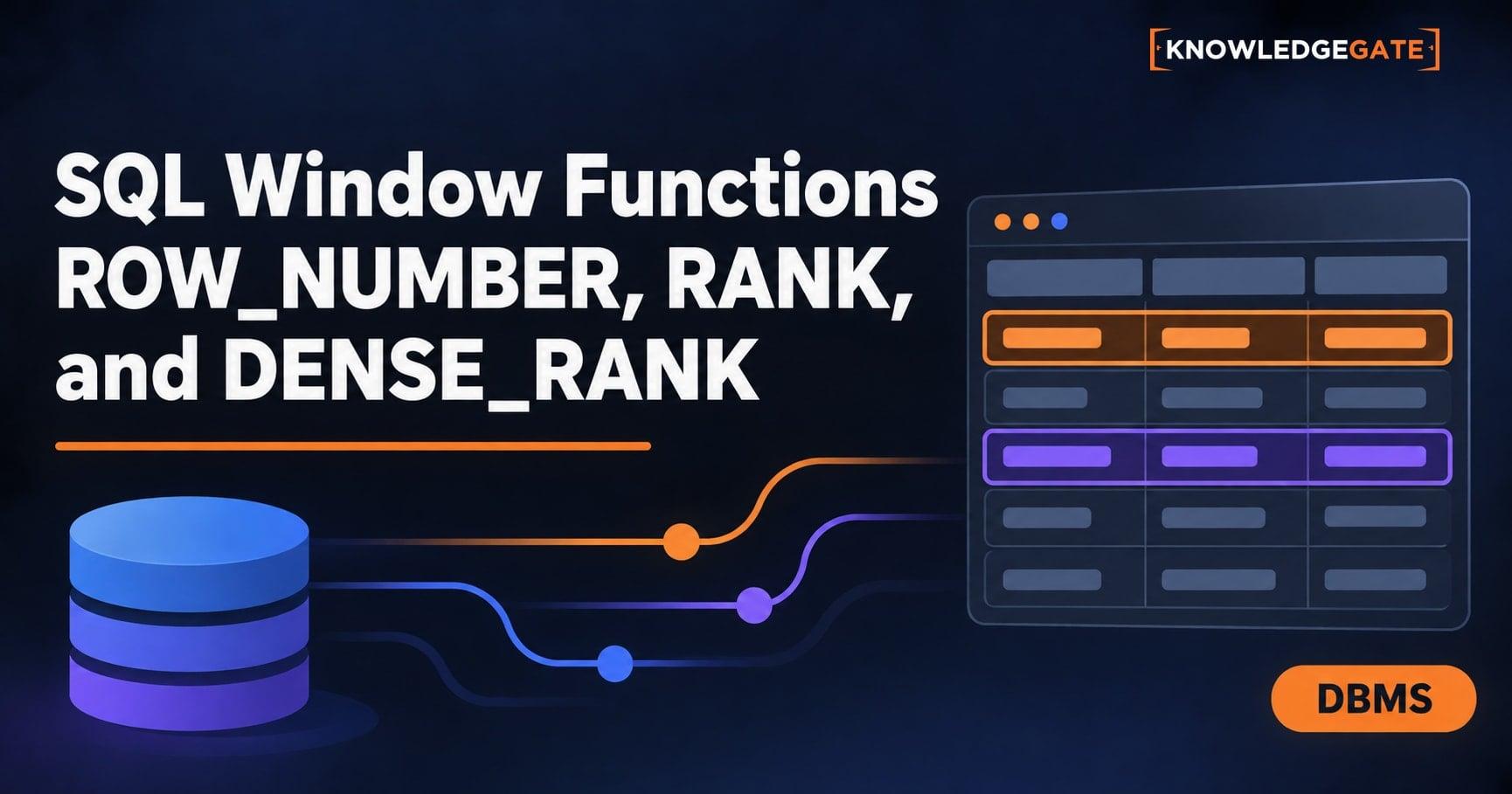
SQL Window Functions Explained: ROW_NUMBER, RANK, and DENSE_RANK with Interview Problems
See why window functions preserve rows, then calculate three ranking columns on the same tied-score table.
Updated 3 Aug 20265 min readDBMS