Floating Point Basics MCQs: 12 Solved Questions with Explanations
Work through 12 solved floating-point MCQs covering fixed versus floating point, normalisation, bias, representation fields, and finite-precision arithmetic.
KnowledgeGate Team
Exam prep & CS education
Updated 24 Aug 20267 min read
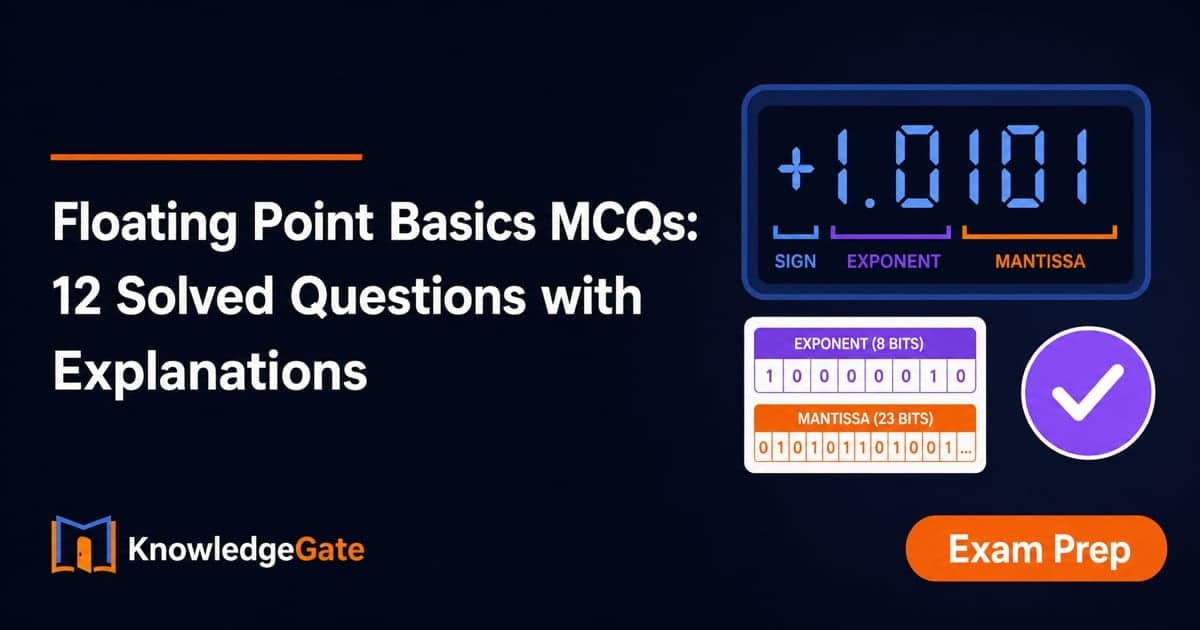
Floating-point questions combine three small rules that are easy to mix up: normalising the mantissa, biasing the exponent, and accepting that finite precision changes arithmetic. A single missed shift can change both the exponent and the stored bits. Use the format stated in each stem, not a memorised default. Attempt each question before reading the answer.
Three habits decide most of these marks. Write the value in the exact form the stem names, pure fraction 0.1xxx or normalised 1.xxxx, because the two conventions give different exponents for the same number. Add the bias only after the exponent is final. Round or truncate at every intermediate step, since a value that is exact on paper may not survive the stored mantissa width. Work slowly and write every intermediate representation. For wider drill on the same topic, use the Floating Point Basics module.
1. Floating point and fixed point: start with the distinction
Floating point represents fractional values and very large or small magnitudes. Its exponent moves the point, but a finite format still approximates many real values.
Q1. DSSSB 2024
Number with decimal points is called _____ in programming language.
(a) Floating point numbers
(b) Complex numbers
(c) Imaginary Numbers
(d) Integer
Answer: (a) Floating point numbers. The name comes from the point moving through an exponent field. That movement provides range, but not every decimal fraction is represented exactly.
Q2. Beltron Programmer 2025
What is a primary limitation of using fixed-point representation for real number arithmetic in digital systems?
(a) It requires floating-point hardware for all arithmetic operations.
(b) It cannot represent negative integers.
(c) It consumes excessive memory for small values.
(d) It offers limited precision for fractional values due to fixed scaling.
Answer: (d) It offers limited precision for fractional values due to fixed scaling. The format fixes the number of bit positions after the point. Values between permitted increments are rounded, while finer scaling leaves less integer range.
2. Normalisation and exponent bias
Normalisation moves the point until the leading significant digit is nonzero, while the exponent compensates. Apply any bias only after finding that exponent.
Q3. MPPSC 2025
A floating point number is said to be normalized, if the left most digit of the mantissa is
(a) Zero
(b) Fraction
(c) Exponent
(d) Nonzero
Answer: (d) Nonzero. Normalisation removes leading zero digits so the available mantissa bits carry significant information. A binary format may write the significand as 1.xxxx or as a pure fraction 0.1xxx; both conventions begin with a nonzero significant bit.
Q4. DSSSB 2018
How will (0.10101)₂ be represented using normalised scientific notation?
(a) 0.010101 x 2¹
(b) 0.10101 x 2⁰
(c) 1.0101 x 2⁻¹
(d) 10.101 x 2⁻²
Answer: (c) 1.0101 x 2⁻¹. Move the binary point one position right to put 1 before it, then compensate with 2^-1. Reversing the move confirms that 1.0101 x 2^-1 = 0.10101.
If that shift is not yet comfortable, revise binary place values in Number Systems and Base Conversions: GATE Worked Examples before continuing.
Q5. Exponent bias with a five-bit exponent field
Suppose that instead of 8 bits, E was only designated 5 bits. What is the bias in this case?
(a) 8
(b) 15
(c) 16
(d) None of these
Answer: (b) 15. The bias rule used here is 2^(k-1) - 1 for k exponent bits. With k = 5, the result is 2^4 - 1 = 16 - 1 = 15.
3. Mantissa range and spacing between representable values
Mantissa width sets the range and adjacent spacing. The exponent scales both.
Q6. GATE 1996
Consider a floating-point representation in which the exponent is stored in 2's complement form and the mantissa is stored in sign-magnitude form with 23 magnitude bits. What is the range of the magnitude of the normalized mantissa in this representation?
(a) 0 to 1
(b) 0.5 to 1
(c) 2⁻²³ to 0.5
(d) 0.5 to (1 − 2⁻²³)
Answer: (d) 0.5 to (1 − 2⁻²³). The minimum is binary 0.100...0, or 0.5. All 23 ones give 2^-1 + 2^-2 + ... + 2^-23 = 1 - 2^-23. See the solved page.
Q7. GATE 2003
The following is a scheme for floating point number representation using 16 bits.
Bit position 15 14 . . . 9 8 . . . . .0
s e m
Sign Exponent Mantissa
Let s,e, and m be the numbers represented in binary in the sign, exponent, and mantissa fields respectively. Then the floating point number represented is:

What is the maximum difference between two successive real numbers representable in this system?
(a) 2⁻⁴⁰
(b) 2⁻⁹
(c) 2²²
(d) 2³¹
Answer: (c) 2²². In (-1)^s(1 + m x 2^-9)2^(e-31), adjacent m values are spaced by 2^(e-40). Pattern 111111 is reserved, so the largest e is 62 and the maximum gap is 2^(62-40) = 2^22. See the solved page.
4. Encode a number into sign, exponent and fraction fields
Write sign, exponent, and fraction separately. These questions use their stated pure-fraction formats, not a generic IEEE 754 layout.
Q8. NIMCET 2017
The representation of a floating-point binary number +1001.11 in 8-bit fraction and 6-bit exponent format is
(a) Fraction : 01001110 exponent : 000100
(b) Fraction : 00001001 exponent : 000011
(c) Fraction : 10010000 exponent : 110000
(d) Fraction: 00100100 exponent :011000
Answer: (a) Fraction : 01001110 exponent : 000100. In pure-fraction form, +1001.11 = +0.100111 x 2^4. Sign 0 plus magnitude 1001110 gives fraction 01001110; exponent +4 becomes 000100.
Q9. GATE 2005
Consider the following floating point format
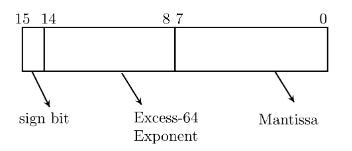
Mantissa is a pure fraction in sign-magnitude form. The decimal number 0.239 × 2¹³
has the following hexadecimal representation (without normalization and rounding off :
(a) 0D 24
(b) 0D 4D
(c) 4D 0D
(d) 4D 3D
Answer: (d) 4D 3D. Bias the unnormalised exponent: 13 + 64 = 77 = 0x4D. Truncate the fraction: floor(0.239 x 256) = 61 = 0x3D. The result is 4D 3D. See the solved page.
Q10. GATE 2005
Consider the following floating point format
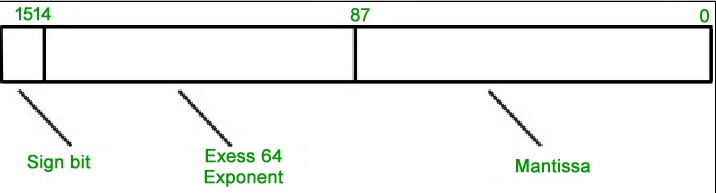
Mantissa is a pure fraction in sign-magnitude form. The normalized representation for the above format is specified as follows. The mantissa has an implicit 1 preceding the binary (radix) point. Assume that only 0's are padded in while shifting a field. The normalized representation of the above number (0.239 × 2¹³) is:
(a) 0A 20
(b) 11 34
(c) 4D D0
(d) 4A E8
Answer: (d) 4A E8. 0.239 begins approximately 0.00111101... in binary, so a three-place shift changes exponent 13 to 10. The biased exponent is 10 + 64 = 74 = 0x4A; shifting 00111101 left with zero padding gives 11101000 = 0xE8. The result is 4A E8. See the solved page.
5. Precision loss makes arithmetic order matter
When two operands differ in exponent by more than the mantissa can hold, the smaller one contributes nothing to the stored sum. That is why the same three values can give two different totals depending on the order you add them.
Q11. ISRO 2008
A computer uses 8 digit mantissa and 2 digit exponent. If a = 0.052 and b = 28E + 11 then b + a - b will
(a) result in an overflow error
(b) result in an underflow error
(c) be 0
(d) be 5.28 E + 11
Answer: (c) be 0. Aligning small a with b pushes it past the eight retained mantissa digits. The stored steps are b + a = b, then b - b = 0.
Q12. GATE 2000
Consider the values A = 2.0 x 10^30, B = -2.0 x 10^30, C = 1.0, and the following floating-point computations:
For X:
X := A + B
X := X + C
For Y:
Y := A + C
Y := Y + B
The computations are executed on a computer where floating-point numbers are represented with 32 bits. The values of X and Y will be:
(a) X = 1.0, Y = 1.0
(b) X = 1.0, Y = 0.0
(c) X = 0.0, Y = 1.0
(d) X = 0.0, Y = 0.0
Answer: (b) X = 1.0, Y = 0.0. Store X: A+B=0.0, then 0.0+C=1.0. Store Y: A+C=A after rounding, then A+B=0.0. Addition is not associative. See the solved page.
6. How floating point representation is tested in exams
Q1 and Q2 test definitions and fixed point versus floating point. Q3 to Q5 test normalisation and bias, Q6 and Q7 test mantissa range and spacing, Q8 to Q10 test field encoding, and Q11 and Q12 test precision loss and operation order.
Use mistakes diagnostically. If Q3 to Q7 went wrong, rebuild powers of two and field conventions. For Q8 to Q10, write sign, exponent, and mantissa as separate rows before packing. For Q11 and Q12, round after every intermediate operation.
7. Floating point in one rule chain, and the next practice step
The rule chain is compact: normalise, adjust the exponent, apply the bias, fit the mantissa, then round or truncate exactly as the format requires. After a gap, reattempt only the items you missed.
Use GATE Guidance by Sanchit Sir for the structured full-subject route and the GATE CS Exam Preparation category for wider preparation. To continue through Computer Organization, work through Pipelining in Computer Architecture: Speedup and Hazards next.
Keep learning

Register & Bus Organization MCQs: 12 Solved Questions with Explanations
Work through 12 Register and Bus Organization PYQs on CPU registers, micro-operations, common-bus multiplexers, tri-state drivers and register windows.
24 Oct 20267 min readComputer Organization MCQs
Data Manipulation Micro-Operations MCQs: 10 Solved Questions with Explanations
Solve 10 micro-operations MCQs with step-by-step explanations of shifts, ALU behaviour, register logic, Booth recoding and control width.
Updated 20 Oct 20267 min readComputer Organization MCQs
Performance & Speedup MCQs: 12 Solved Pipelining Questions
Work through 12 solved pipelining questions step by step, from finite pipeline time and latch overhead to bubbles, MIPS, CPI and bottleneck splitting.
Updated 16 Oct 20268 min readComputer Organization MCQs
Multiprocessor Classification MCQs: 8 Solved MCQs and 2 Concept Checks
Work through the complete mapped pool: eight objective items plus two optionless concept checks. Explanations cover Flynn's taxonomy, coupling, bus facts, and parallel efficiency.
12 Oct 20267 min readComputer Organization MCQs