IBPS Clerk State and Language Choice: Decide Before Applying
Choose an IBPS Clerk State or UT and listed language through three decision gates: location commitment, exact language match, and functional four-skill ability.
KnowledgeGate Team
Exam prep & CS education
Updated 4 Sep 20265 min read
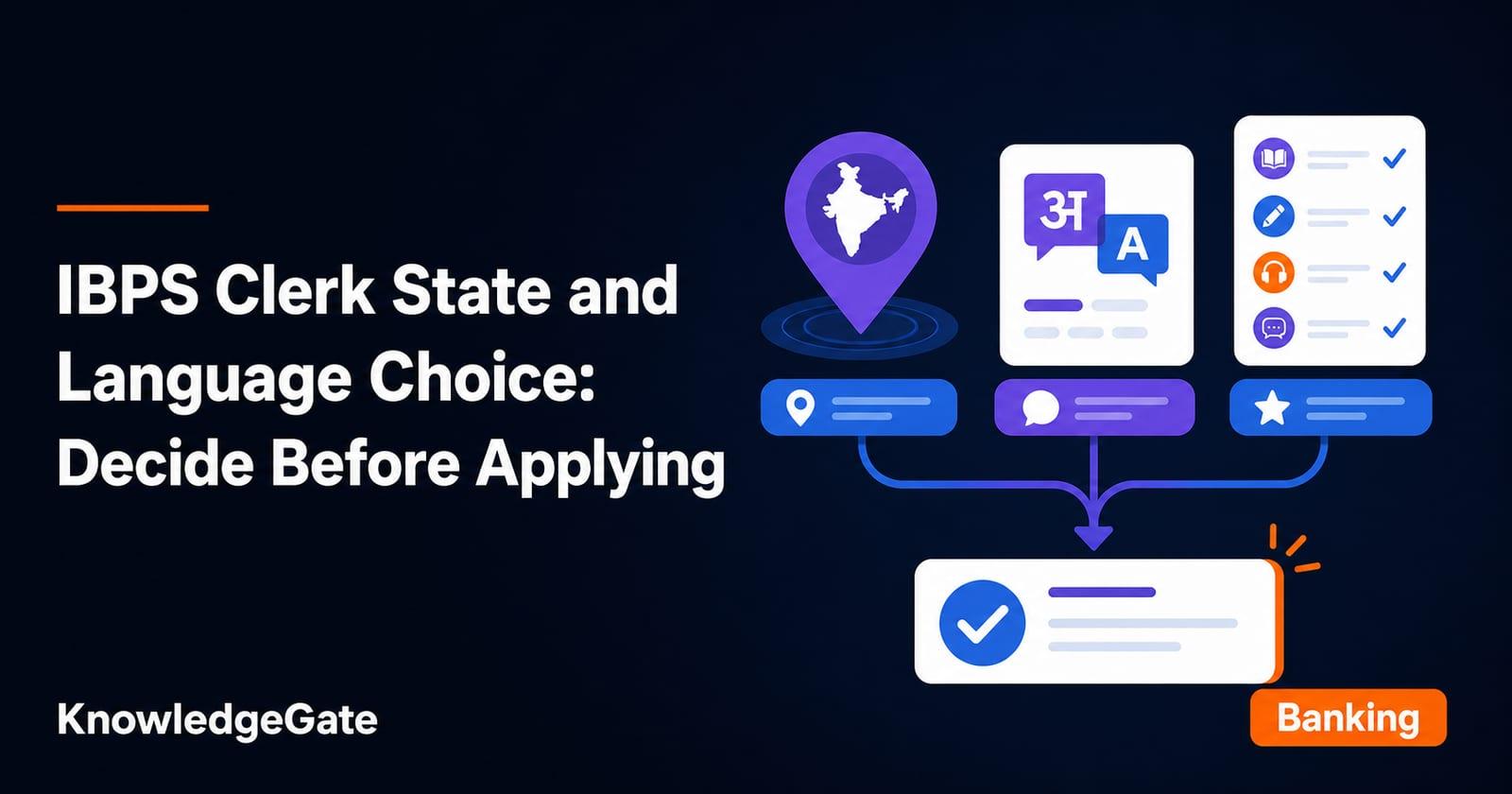
An IBPS Clerk State or UT selection is not just a vacancy preference. It also fixes the local-language context attached to that application choice. The practical question comes before preparation: can you accept the location and serve customers in one permitted language without relying on a last-minute rescue plan? Use the current notification for your cycle because completed-cycle evidence is dated.
IBPS Clerk State and language choice: treat location and language as one decision
The completed CRP CSA-XV detailed notification paired each State or UT in Annexure III with one or more specified or opted local languages. Clause H described proficiency through reading, writing, speaking and understanding. Your current-cycle notification remains the authority if its list or process differs.
The IBPS Clerk Language Proficiency Test: State-Wise Rules and a 14-Day Practice Plan supplies the dated CSA-XV State and UT language table plus a short four-skill drill. Use that table to identify permitted pairs. Then apply three separate gates: willingness to take the location, an exact language match, and honest functional ability.
Gate 1: remove locations you would not actually accept
Start with the job location, not the language you find easiest. A familiar language does not make an unsuitable State or UT a sensible application choice. Ask whether you would genuinely accept the posting conditions described for that recruitment, live with the location decision, and complete joining formalities there if selected.
Write yes, conditional, or no beside every State or UT you are considering. A condition must be concrete, such as a family constraint or a relocation limit. “I will decide after selection” hides the trade-off instead of resolving it.
Remove every no before comparing languages. Keep a conditional option only if you know what must be resolved before the application is submitted. The notification's vacancy and eligibility sections, not an exam-centre preference or a coaching list, decide whether an option is available to you.
Gate 2: match the exact listed language, not a nearby substitute
Read the language name exactly as the notification prints it for the chosen State or UT. Do not replace it with a language that is common in the region but absent from that row. Do not assume that a related dialect, a similar script, or general English ability will count as the listed option.
Where a State or UT offers more than one language, treat each as a separate candidate choice. Record only the language you can defend across all four abilities. Family use may support speaking and understanding while leaving reading or writing weak, so “spoken at home” is useful evidence but not the whole decision.
Your shortlist should now contain pairs, not loose locations: State or UT + exact listed language. If either half changes, reassess the pair from the beginning.
Gate 3: check functional ability before you promise future improvement
Use four yes-or-no evidence questions. They are a choice filter, not an official LLPT format or qualifying score.
Can you read a routine public notice in the script without transliterating every line?
Can you write six clear sentences that preserve names, dates and instructions?
Can you understand a normal-speed explanation from an unfamiliar speaker?
Can you explain a simple branch instruction in complete sentences without switching languages for every technical word?
Four honest yes answers make the language a defensible option. One no answer makes it conditional and identifies the exact ability that needs work. Several no answers mean the pair carries real risk; do not convert that risk into confidence merely because the application deadline is near.
This check does not predict a bank's test result. It prevents a weaker but important ability, usually script use or formal writing, from disappearing behind conversational confidence.
Sort each State-language pair into one of three envelopes
Use three envelopes instead of an invented numerical score:
Reject: the location is unacceptable, the language is not listed for it, or you cannot support the choice across several abilities.
Conditional: the location works and the language is listed, but one ability is weak or one practical constraint is unresolved.
Defensible: the location works, the exact language is listed, and all four abilities have current evidence.
A pair moves from conditional to defensible only when the named condition changes. Extra mock-test marks in the online exam do not answer a local-language weakness. Likewise, better speaking does not repair unreadable script or inaccurate writing.
If two pairs remain defensible, prefer the one supported by wider real-life use: regular reading, writing messages, understanding unfamiliar speakers, and explaining formal instructions. Familiarity across contexts is stronger evidence than one memorised passage or one relative's reassurance.
Freeze the decision in a one-page application record
Before submission, keep a short record of the reasoning:
State or UT:
Exact listed language:
Location decision and any condition:
Reading evidence:
Writing evidence:
Speaking evidence:
Understanding evidence:
Weakest ability, if any:
Alternative rejected and reason:
Notification cycle and date checked:
This record protects against three common memory errors: confusing a language you considered with the one selected, forgetting why a location was rejected, and mistaking future practice for present ability. Match the final application preview to the record before submission. If the portal wording or current notice conflicts with your notes, stop and follow the official material.
IBPS Clerk application choice: the final five checks
Confirm five points before you lock the selection:
The State or UT is available under the current notification and is a location you would accept.
The language is printed for that exact State or UT.
The same pair appears in your application preview.
Reading, writing, speaking and understanding each have real evidence.
Any conditional item has been resolved, not merely postponed.
Once the pair is fixed, move to the earlier sibling's 14-day practice drill if an ability needs strengthening. For the separate online-exam stage, Banking & Insurance Exam Preparation provides the wider subject map, while the IBPS PO Prelims Preparation Course is relevant only to broader banking aptitude and English preparation. Neither replaces the State-language decision or determines LLPT qualification.
Keep learning
IBPS Clerk Cutoff Trends: Set a Defensible Target Score
Turn comparable official cutoff values into a practical working target, then use mock accuracy and consistency to decide what to repair next.
Updated 24 Oct 20264 min readIBPS Exams
IBPS SO IT Officer Syllabus: What to Study for Each Section
Separate the official IBPS exam structure from the detailed study map. See what to cover for English, Reasoning, Quantitative Aptitude, Professional Knowledge and Descriptive English.
Updated 21 Oct 20264 min readIBPS Exams
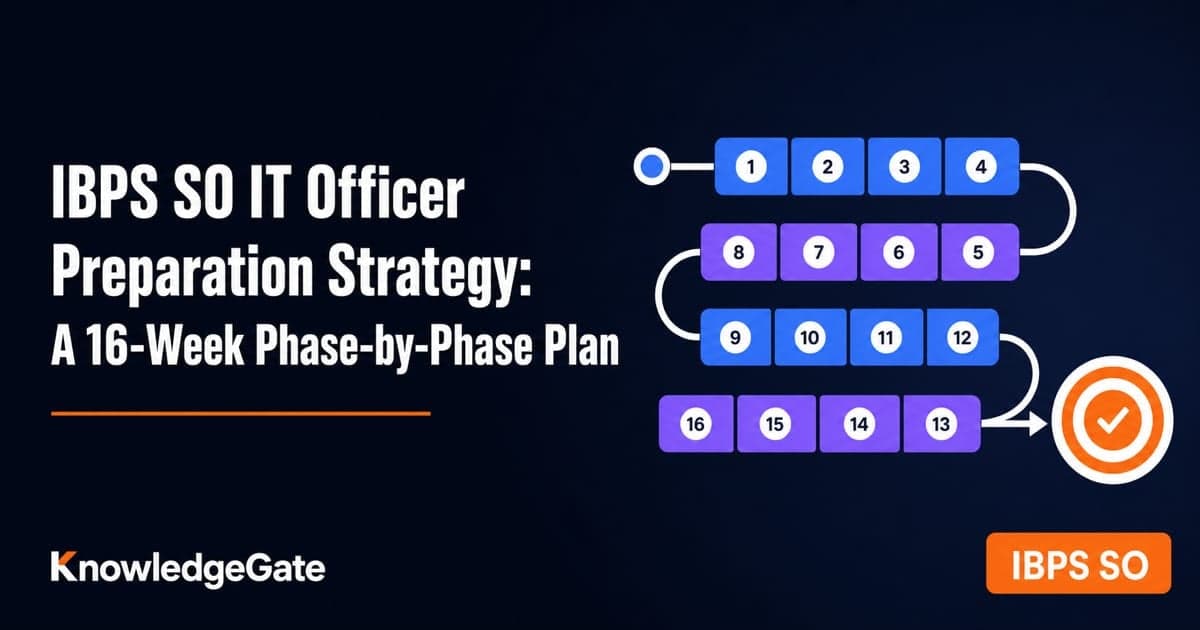
IBPS SO IT Officer Preparation Strategy: A 16-Week Phase-by-Phase Plan
Turn 18 weekly hours into a realistic IBPS SO IT Officer plan, from the first diagnostic to mock repair, tapering and a conditional next-stage bridge.
Updated 17 Oct 20266 min readIBPS Exams
IBPS SO IT Officer Exam Pattern and Marking Scheme: Prelims, Mains and Interview
Understand the CRP SPL-XVI stage sequence, section timings and marks, then use worked score calculations and a 12-hour study plan to prepare for each stage.
Updated 13 Oct 20264 min read129 viewsIBPS Exams