Operating Systems
53 articles in this topic

Memory management in OS: paging and segmentation explained
Memory management is how an operating system decides where each process lives in physical memory and maps program addresses to hardware locations. Correct mapping lets many processes share memory safely; bad mapping wastes space through fragmentation or causes invalid access. Most exam questions reduce to one skill: translating a logical address into a physical one.
Updated 16 Jul 20265 min readOperating Systems

CPU scheduling algorithms: FCFS, SJF, Round Robin and priority explained
When several processes are ready to run and there is one CPU, the operating system has to choose who goes next. That choice is CPU scheduling, and the algorithm it uses decides how long each process waits and how responsive the system feels. It is almost entirely mechanical: draw a Gantt chart, read off the completion times, and two subtractions give you everything an exam question asks for. Four processes, four algorithms, and the same two averages come out different every time.
Updated 29 Jul 20266 min read323 viewsOperating Systems

Process Synchronization and Semaphores: race conditions, Peterson's solution, wait and signal
Process synchronization explained: the race condition, critical-section problem, Peterson's solution, binary and counting semaphores, and a worked trace.
Updated 14 Jul 20266 min read149 viewsOperating Systems

Memory Hierarchy and Virtual Memory: paging, the TLB, and address translation
Memory hierarchy and virtual memory explained: registers to disk, locality, paging, page tables, the TLB, a worked address translation, and access time.
Updated 25 Jul 20265 min read67 viewsOperating Systems
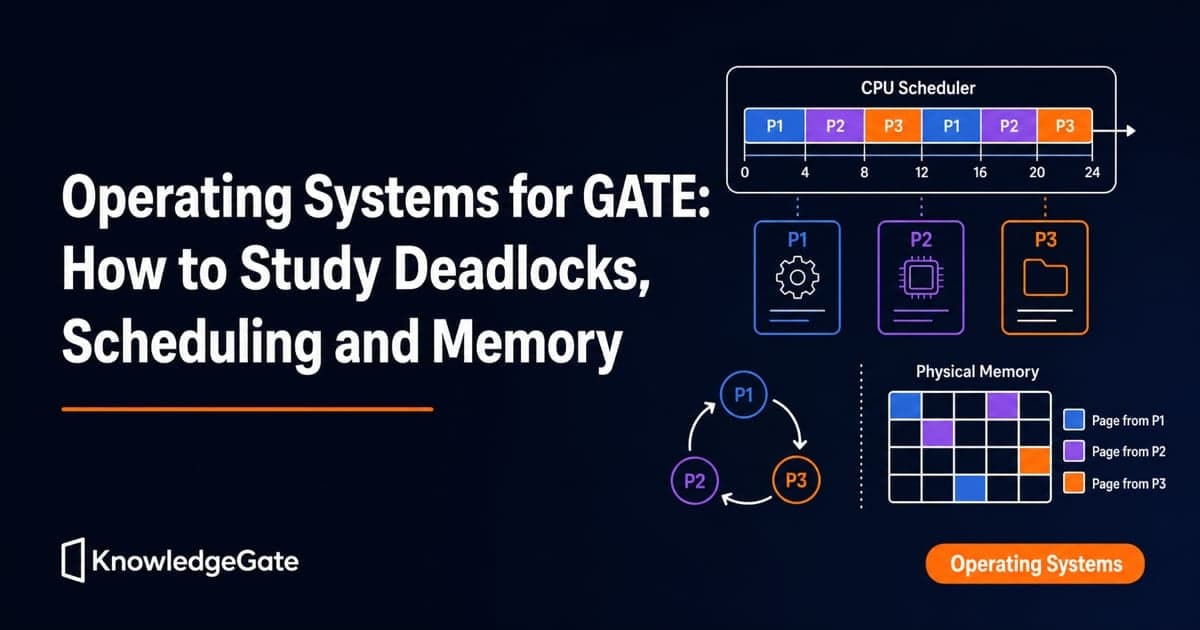
Operating Systems for GATE: How to Study Deadlocks, Scheduling and Memory
Operating Systems is one of the densest, most-tested GATE CS subjects. Here is how to study its three biggest areas (scheduling, deadlocks and memory) so the marks actually come.
Updated 26 Jul 202610 min read157 viewsOperating Systems