DBMS
53 articles in this topic
SQL Tutorial: The Complete Learning Path from First Query to Transactions
Learn SQL in a deliberate order, using one small dataset to practise table creation, filtering, joins, grouping, subqueries and transactions.
Updated 8 Aug 20267 min readDBMS
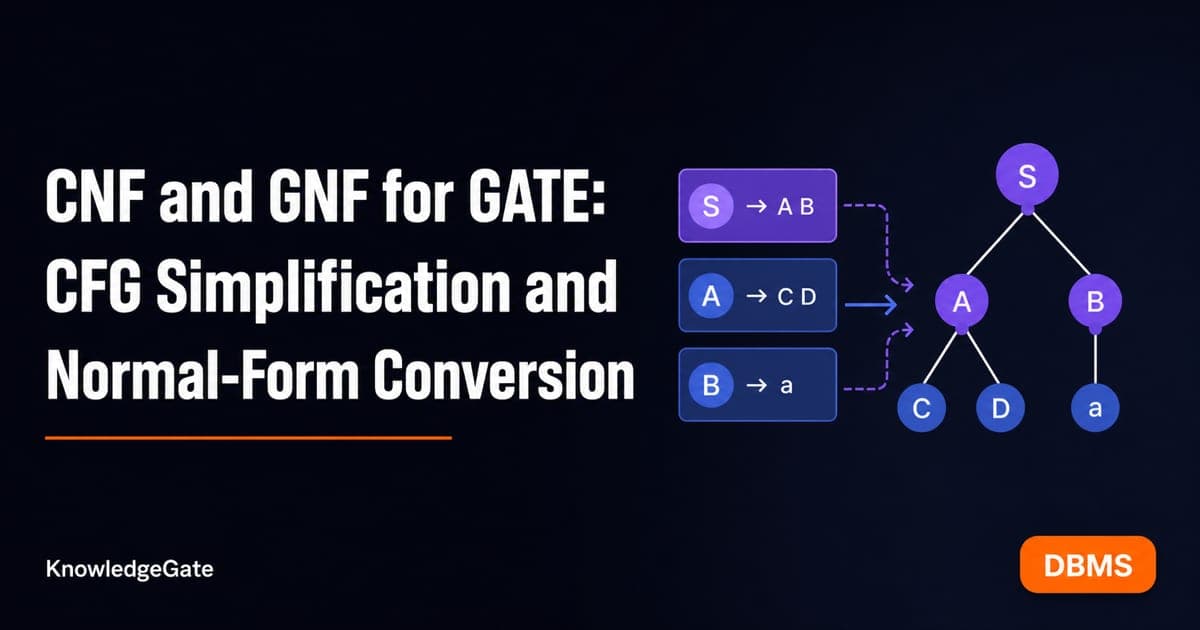
CNF and GNF for GATE: CFG Simplification and Normal-Form Conversion, Step by Step
Run epsilon, unit and useless-production removal in the right order, convert one full grammar to CNF, and verify the two derivation-count formulas.
Updated 6 Aug 20267 min read55 viewsDBMS
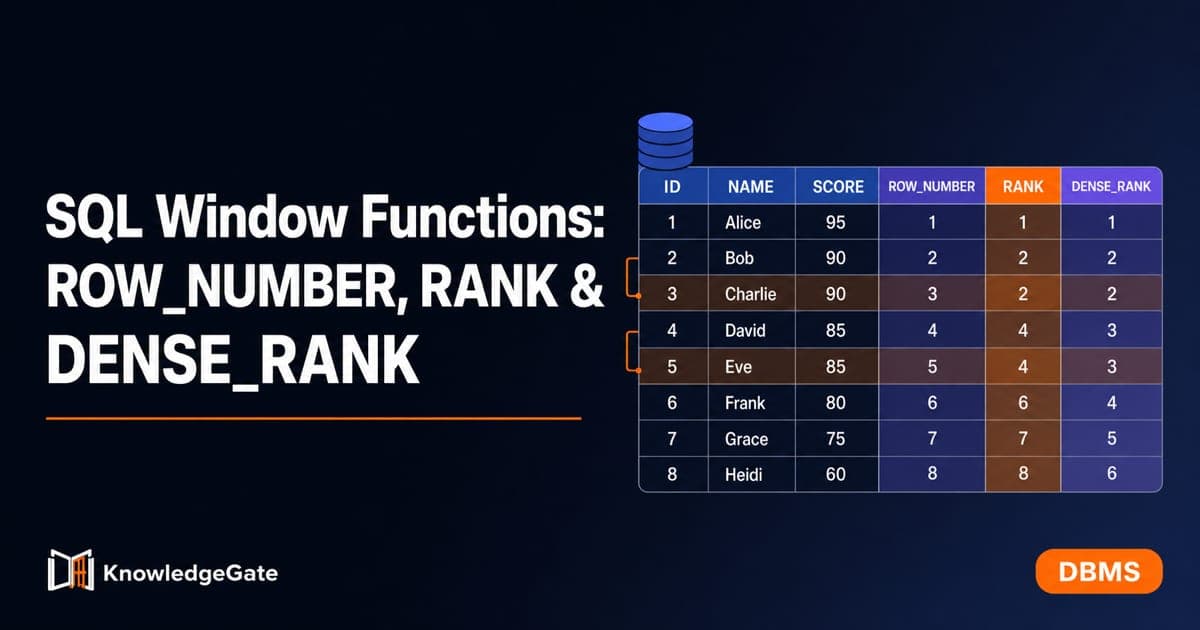
SQL Window Functions Explained: ROW_NUMBER, RANK, and DENSE_RANK with Interview Problems
See why window functions preserve rows, then calculate three ranking columns on the same tied-score table.
Updated 3 Aug 20265 min readDBMS
File Organization and Indexing in DBMS for GATE: Dense, Sparse, Primary and Secondary Indexes
Build one sorted file, count its blocks, and index it in enough ways to make dense, sparse, primary, secondary, and multilevel questions routine.
Updated 1 Aug 20266 min readDBMS
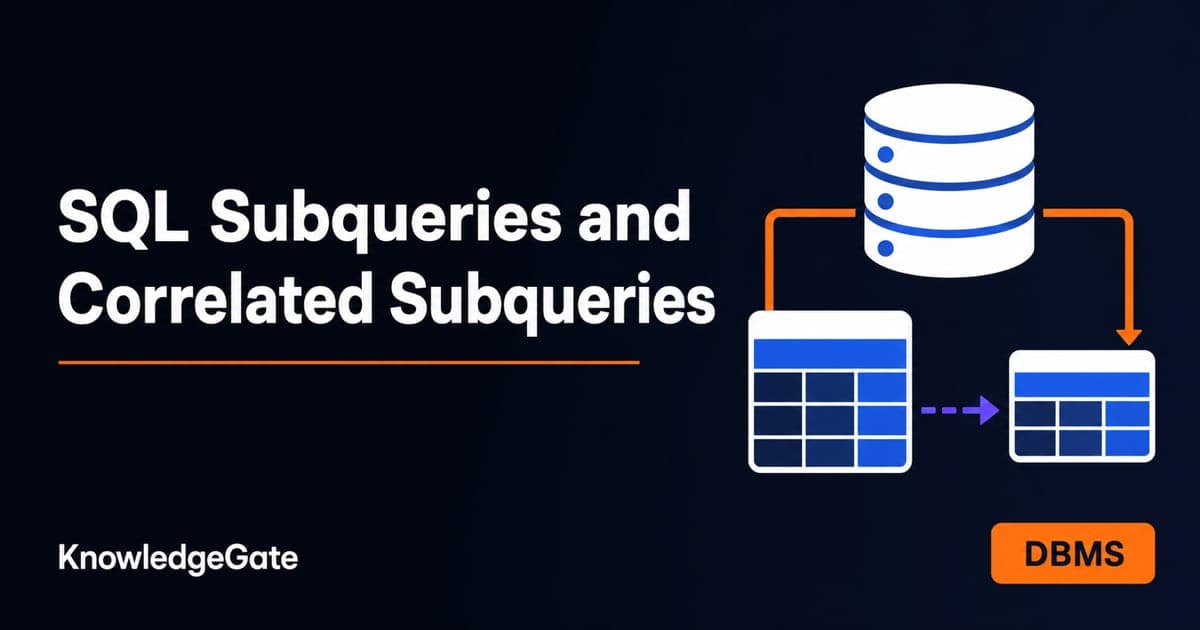
SQL Subqueries and Correlated Subqueries: How to Read, Write and Solve Placement-Test Questions
Read nested SQL from the inside out, distinguish once-only and per-row evaluation, and solve common placement questions with one small employee dataset.
Updated 29 Jul 20265 min readDBMS
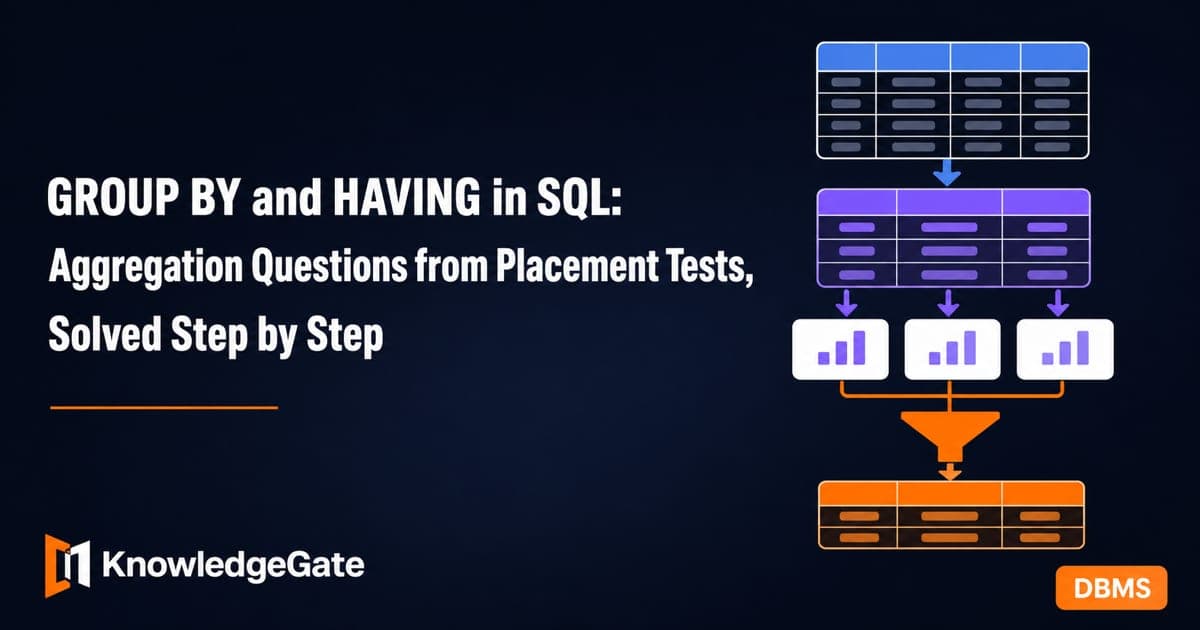
GROUP BY and HAVING in SQL: Aggregation Questions from Placement Tests, Solved Step by Step
Trace two placement-style SQL queries from raw rows to grouped results. Learn exactly when to use WHERE, HAVING, COUNT(*), and COUNT(column).
Updated 26 Jul 20265 min readDBMS

Cyber Threats and Malware Attacks: Types, Attack Chains and a Worked Incident
Learn to separate vectors, techniques and payloads, classify mixed malware behaviour, calculate exposure, and map controls to each incident stage.
Updated 26 Jul 20266 min readDBMS
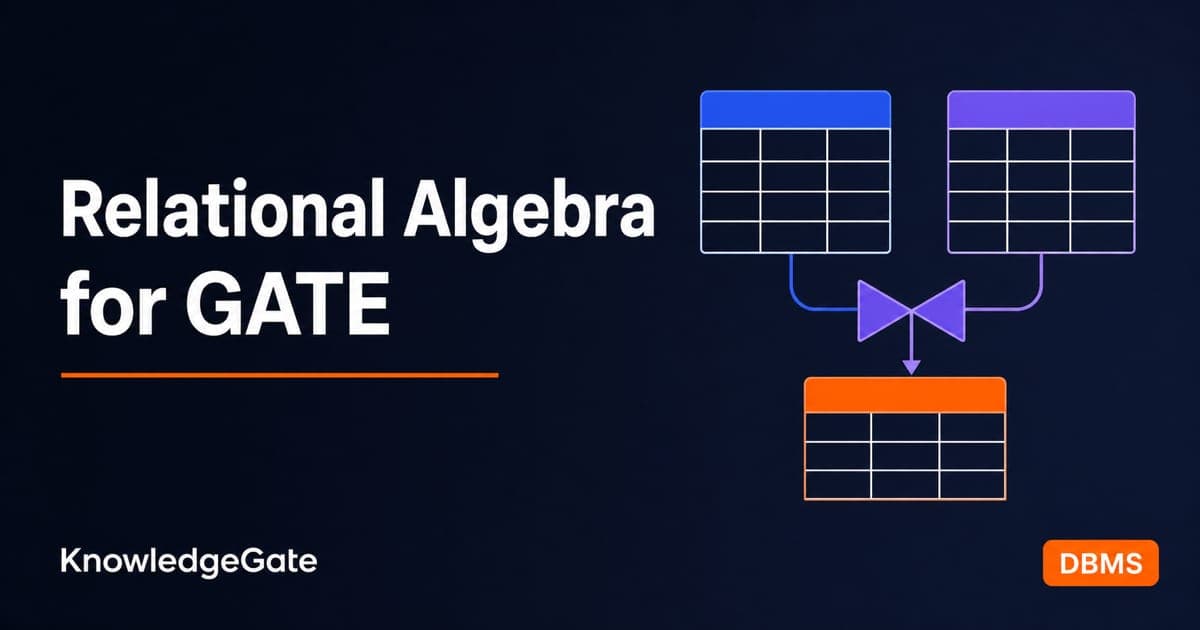
Relational Algebra for GATE: Operators, Tuple-Counting and Query Equivalence Drills
Calculate set, join, and outer-join cardinalities on concrete relations, then use selection and projection pushdown without changing query meaning.
Updated 21 Jul 20266 min readDBMS
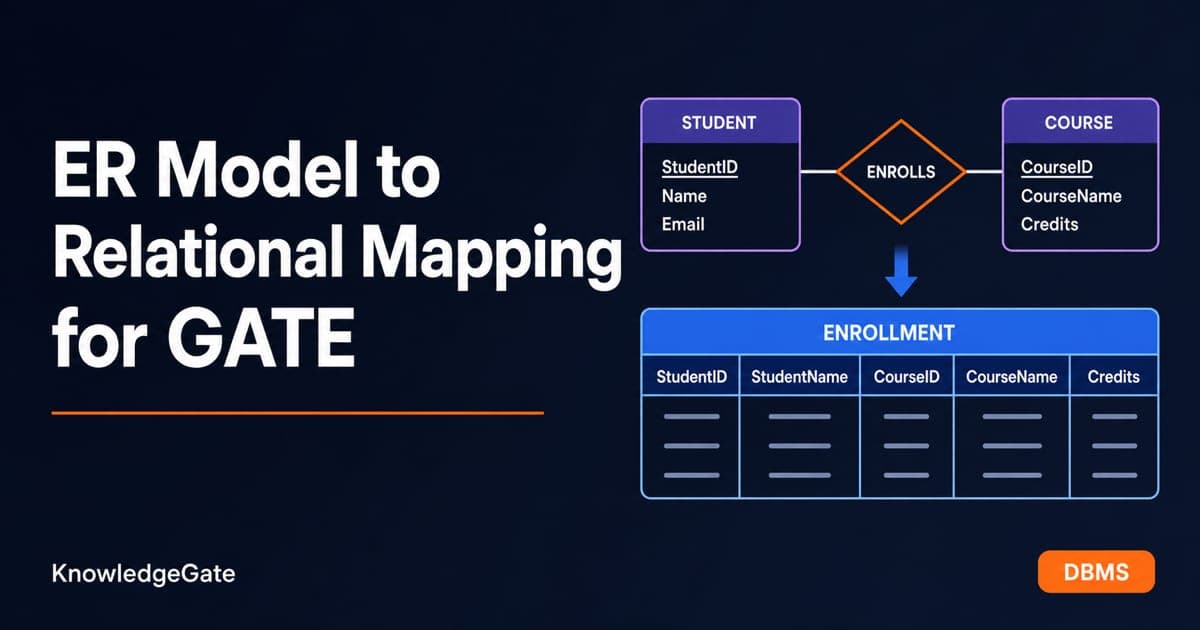
ER Model to Relational Mapping for GATE: Minimum Number of Tables Questions Solved
Count the minimum relations from cardinality and participation, then check the special rules for weak entities, relationship attributes, and multivalued attributes.
Updated 20 Jul 20266 min read92 viewsDBMS

SQL Queries for Placement Interviews: Second Highest Salary, Joins and GROUP BY Step by Step
SQL queries for placement interviews built step by step on one schema: second highest salary three approaches, joins with results shown, GROUP BY and HAVING.
Updated 19 Jul 20267 min readDBMS
DBMS Interview Questions for Freshers: Top 50 with Answers That Survive Follow-Ups
50 DBMS interview questions for freshers, grouped the way interviews actually run: keys, the normalization-to-BCNF-to-denormalization chain, SQL joins, transactions and isolation levels, and indexing, answered as chains so rote definitions become explanations.
Updated 23 Jul 202611 min read95 viewsDBMS
IBPS SO IT Officer DBMS: the professional knowledge topics that matter
The DBMS core of the IBPS SO IT Officer Mains Professional Knowledge paper: the ER model, keys, normalization with a worked example, SQL essentials and transactions, and how each is tested.
Updated 26 Jul 20266 min read1.2k viewsDBMS